
Website for Aparthotel: Apartment Booking, Long-Term Rentals & Payments
How to create a website for an aparthotel to automate apartment bookings, manage long-term rentals, online payments, and integrate with CRM/PMS. Practical recommendations for owners of serviced apartments and management companies.
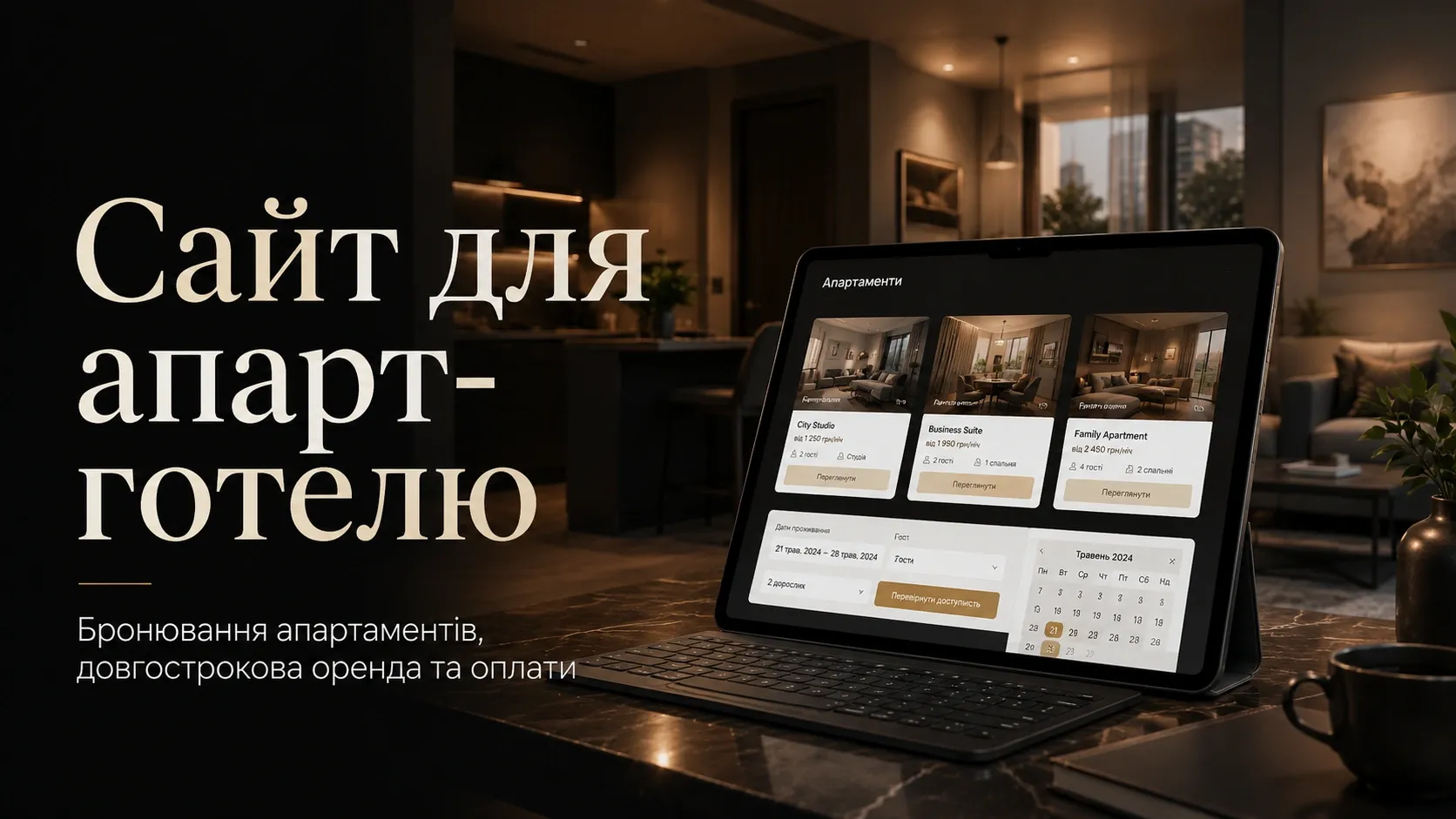
Aparthotels and serviced apartments are businesses where every vacant day means lost revenue. If your website doesn’t allow guests to book apartments independently, check availability in a calendar, pay online, and sign contracts, you’re losing customers to Booking.com, Airbnb, and competitors with more convenient services.
In this article, we’ll explore how a website for an aparthotel helps:
- Sell stays directly, avoiding aggregator commissions.
- Manage apartment occupancy through availability calendars and dynamic pricing.
- Automate guest communication from booking to checkout.
- Integrate with CRM/PMS to eliminate manual data entry and errors.
Why an Aparthotel Needs Its Own Website, Not Just Aggregator Profiles
Many aparthotel owners rely on Booking.com or Airbnb, believing this is sufficient. However, aggregators take 10–30% commission per booking, limit communication with guests, and offer no control over branding. Here are the key advantages of having your own website:
| Problem with Aggregators | Advantage of a Custom Website |
|---|---|
| High booking commissions | Direct bookings without intermediaries |
| Limited brand control | Full customization of design and content |
| No direct guest contacts | Building a customer database for repeat sales |
| Dependence on aggregator algorithms | Ability to run your own marketing campaigns |
| No flexible pricing | Dynamic pricing based on season and demand |
A custom website isn’t an alternative to aggregators—it’s an additional sales channel that reduces dependence on intermediaries and increases profitability.
Key Features of an Aparthotel Website
1. Apartment Catalog with Filters and Detailed Information
Guests should quickly find apartments that meet their needs. The catalog must include:
- Filters by parameters: number of bedrooms, floor, kitchen availability, balcony, parking, crib, etc.
- Photos and virtual tours: professional interior shots, video tours, and 3D tours help guests visualize their stay.
- Apartment descriptions: details about area, location (proximity to metro, city center), amenities (washing machine, air conditioning, Wi-Fi).
- Guest reviews: honest reviews with photos and ratings build trust in the property.
Example: If you offer apartments with and without kitchens, filters help guests narrow down their search immediately.
2. Availability Calendar and Apartment Booking
The calendar is the heart of an aparthotel website. It should display:
- Real-time apartment status: "Available," "Booked," or "Maintenance" (e.g., cleaning after checkout).
- Flexible booking: guests select check-in/check-out dates, and the system automatically calculates the price based on stay duration and seasonality.
- Minimum and maximum booking terms: e.g., a minimum of 2 nights for short-term rentals or 30 days for long-term stays.
- Date blocking: the ability to close certain dates for bookings (e.g., for maintenance).
Important: The calendar must sync with all sales channels (your website, Booking.com, Airbnb) to avoid double bookings.
3. Short-Term and Long-Term Bookings
Aparthotels often operate in two modes:
- Short-term rentals (daily, a few days) — for tourists and business travelers.
- Long-term rentals (from a month) — for students, corporate clients, or those temporarily relocating.
The website must support both options with these features:
- Short-term booking:
- Online payment of the full amount or deposit.
- Automatic booking confirmation and check-in details.
- Option to select additional services (transfer, cleaning, bike rental).
- Long-term rental:
- Price calculation with discounts for longer stays.
- Online contract signing (electronic signature or uploaded scan).
- Payment schedule (e.g., monthly).
Example: If a guest books an apartment for 3 months, the system automatically applies a 15% discount and generates a payment schedule.
4. Online Payments and Secure Payment Systems
Security and convenience of payment are critical for conversion. The website must support:
- Multiple payment methods: bank cards (Visa, Mastercard), Google Pay, Apple Pay, payment systems (LiqPay, Fondy, WayForPay).
- Installment or partial payment: e.g., 30% deposit at booking, the rest at check-in.
- Automatic invoice and receipt generation: for corporate clients or those needing documents for business trips.
- Fraud protection: card verification, limits on payment attempts, integration with anti-fraud systems.
Tip: Offer guests the option to pay later (e.g., within 24 hours) but with automatic cancellation if unpaid.
5. Contracts and Document Workflow for Long-Term Rentals
For long-term rentals, a legally binding contract is necessary. The website must allow:
- Online contract generation: based on a template with guest and apartment details.
- Electronic signatures: integration with eSign services (e.g., DocuSign, Ukrainian eSignature).
- Document uploads: passport, tax ID (for individuals) or company details (for legal entities).
- Automatic contract copies: sent to the guest and administrator via email.
Important: The contract must include payment terms, penalties for rule violations, termination procedures, and deposit refund conditions.
6. Guest Personal Account
The guest account is where they can manage their bookings, view order history, and communicate with the administration. Key features:
- Booking history: guests can see all their past and current bookings.
- Booking management: ability to extend stays, cancel bookings (according to contract terms), or change dates.
- Payments and invoices: view receipts, pay for additional services.
- Communication with administration: built-in chat or contact form.
- Loyalty program: earning bonuses for repeat bookings, referral programs.
Example: If a guest forgets to extend their booking, the account automatically sends a reminder 2 days before checkout.
7. Integration with CRM and PMS for Process Automation
Without integration with CRM or PMS (Property Management System), the website becomes another manual tool requiring constant oversight. Key benefits of integration:
- Booking synchronization: all orders from the website, aggregators, and phone calls go into one system.
- Price management: dynamic pricing based on demand, season, and stay duration.
- Automated communication: sending emails and SMS (booking confirmations, check-in reminders, post-stay review requests).
- Analytics and reports: tracking occupancy, average check, booking sources, conversion rates.
- Accounting integration: automatic generation of invoices and receipts.
Popular PMS for Aparthotels:
- Cloudbeds: integration with websites, sales channels, and payment systems.
- HotelTime: local solution with Ukrainian language and legal compliance.
- Guesty: for managing multiple properties and automating operations.
How to Choose a Developer for an Aparthotel Website
Not every web studio can handle the specifics of aparthotels. Look for these criteria:
1. Experience in Hospitality Website Development
Check the studio’s portfolio: do they have cases with hotel booking, availability calendars, or PMS integrations? If so, ask for demo access to the admin panel to evaluate usability.
2. Ready-Made Solution or Custom Development?
- Ready-made solution (e.g., WordPress + WooCommerce or specialized platforms like Hostaway, Rentlio) suits small aparthotels with standard requirements. Pros: quick implementation, lower cost. Cons: limited customization.
- Custom development is needed if you have complex business processes (e.g., different contract types for short-term and long-term rentals) or plan to scale. Pros: full adaptation to your needs, high performance. Cons: higher cost and longer development time.
3. Integration with Your Systems
Clarify whether the studio has experience integrating with:
- Your CRM/PMS (if already in use).
- Payment systems (LiqPay, Fondy, WayForPay).
- Sales channels (Booking.com, Airbnb API).
- Electronic signature systems.
4. Support and Training
Ask if the cost includes:
- Training for your staff on using the admin panel.
- Technical support after launch.
- System updates for legal changes (e.g., electronic receipt requirements).
5. Cost and Timeline
Estimated cost of an aparthotel website:
- Ready-made solution: from $1,500 (based on templates).
- Custom development: from $6,000 (depends on complexity).
Development timelines:
- Ready-made solution: 2–4 weeks.
- Custom development: 2–6 months.
Step-by-Step Plan for Launching an Aparthotel Website
-
Define Website Requirements
- List necessary features (catalog, calendar, payments, contracts, etc.).
- Identify required integrations (CRM, payment systems, aggregators).
- Outline business logic (booking conditions, cancellation, refunds).
-
Choose a Developer
- Contact several studios, request proposals and demos.
- Check client reviews and case studies.
-
Develop Structure and Design
- Create a website prototype (wireframe) with key pages and functions.
- Approve the design, ensuring usability and brand alignment.
-
Development and Testing
- Developers implement the website functionality.
- QA specialists test the calendar, payments, and booking processes.
- Fix all errors before launch.
-
Content Population
- Add apartments with photos, descriptions, and prices.
- Include information about stay conditions, rules, and contacts.
- Set up SEO (meta tags, alt text for images, sitemap).
-
Launch and Promotion
- Migrate the website to hosting and connect the domain.
- Set up analytics (Google Analytics, Facebook Pixel).
- Launch ad campaigns (Google Ads, social media).
-
Training and Support
- Train staff on using the admin panel.
- Sign a technical support agreement.
Conclusion: A Website as a Tool for Increasing Aparthotel Profit
A website for an aparthotel isn’t just a business card—it’s a working tool that:
- Increases direct bookings, reducing dependence on aggregators.
- Automates routine processes (bookings, payments, communication), freeing time for business growth.
- Builds guest trust through convenient service and transparent conditions.
- Enables flexible pricing and loyalty programs.
If you’re still managing bookings manually via Excel or phone calls, it’s time to automate. Start with an audit of current operations: which steps take the most time? Where do errors and lost customers occur? Based on this, create a technical specification for the developer and choose a solution that meets your needs.
Investing in a quality website will pay off within months through increased conversions and reduced manual booking processing costs.
Need a website for your aparthotel with booking and payments?
Tell us about your property, and we’ll offer a solution that automates sales and reduces manual work. No templates—only custom development tailored to your needs.
FAQ
Can an aparthotel website integrate with Booking.com and Airbnb?
Yes, a quality aparthotel website supports integration with sales channels via API. This allows syncing availability calendars, prices, and bookings between your website and aggregators, avoiding double bookings.
Which payment systems are suitable for an aparthotel website?
For the Ukrainian market, LiqPay, Fondy, and WayForPay are optimal. They support bank card payments (Visa, Mastercard), Google Pay, Apple Pay, and meet European security standards (PCI DSS).
How to automate guest communication through the website?
For this, the website integrates with CRM or PMS (e.g., Cloudbeds, HotelTime). The system automatically sends emails/SMS at each stage: booking confirmation, check-in reminders, post-stay review requests, etc.
Can contracts be signed online on an aparthotel website?
Yes, the website can generate contracts from templates and allow guests to sign them electronically (via integration with eSign services like DocuSign or Ukrainian eSignature). This is especially relevant for long-term rentals.
How much does it cost to develop an aparthotel website?
The cost depends on the chosen solution. A ready-made template-based solution starts at $1,500, while custom development starts at $6,000. The exact price depends on the number of apartments, integration complexity, and additional features (e.g., loyalty programs).
How to choose a CRM for an aparthotel?
Focus on CRM/PMS specialized in hospitality. Popular options: Cloudbeds (cloud-based with Ukrainian language support), HotelTime (local solution), Guesty (for managing multiple properties). Ensure it integrates with your website and aggregators.