
Telegram Bot for Auto Service: How to Automate Appointments, Reminders, and Requests
How a Telegram bot helps auto services avoid lost requests, respond to clients faster, automate appointments, send reminders, and forward inquiries to CRM.
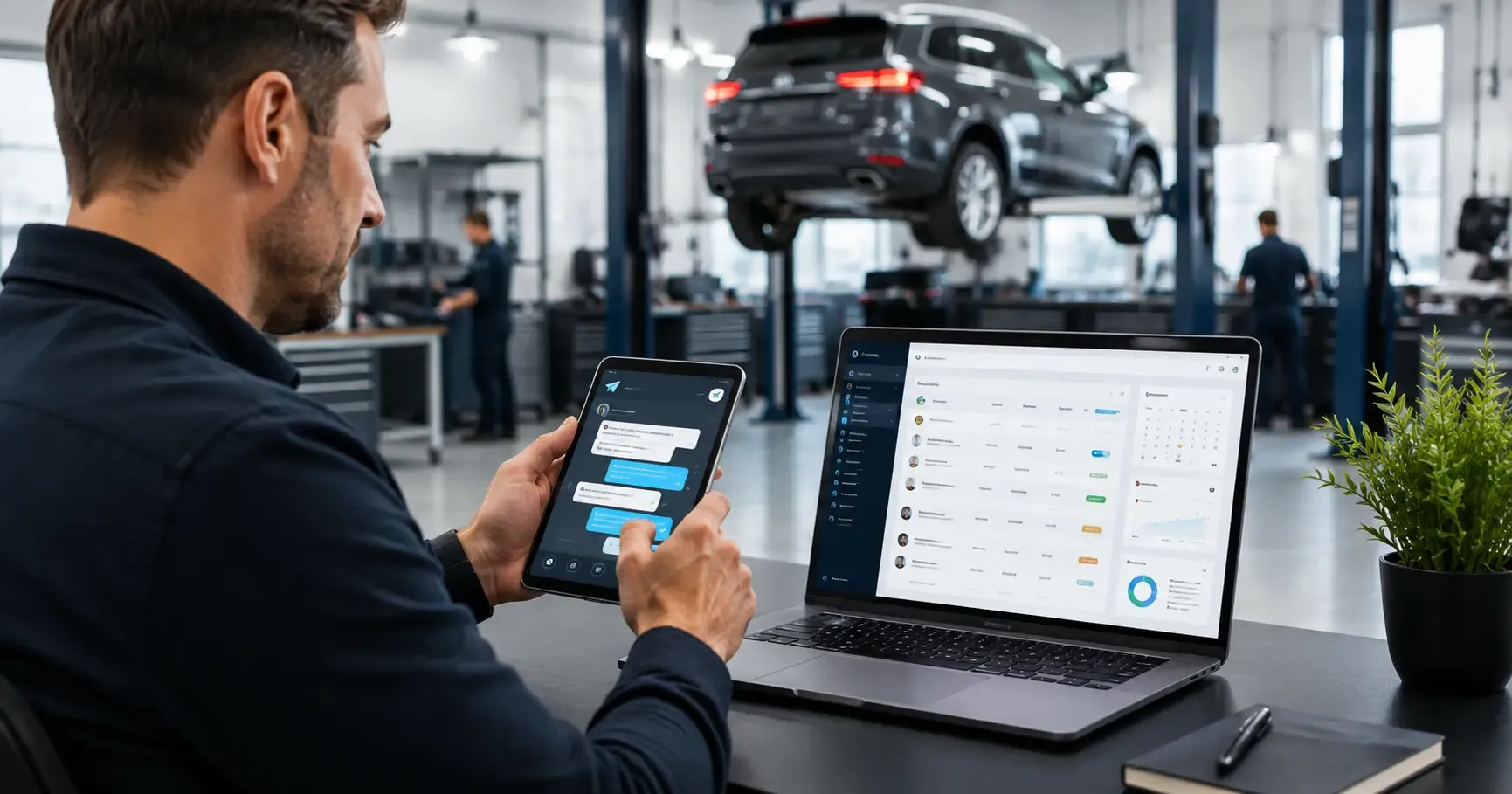
Owners of auto repair shops, tire services, and detailing studios know well: clients often choose not the service with the cheapest or highest-quality repairs, but the one that responds fastest to messages in Telegram or Viber. If an administrator fails to respond within an hour, the client is already reaching out to competitors.
The problem isn’t that your service is poor. The issue is that communication with clients remains manual, chaotic, and unscalable. Requests get lost in chats, reminders about appointments are forgotten, and client contacts don’t make it into CRM. The result is lost sales, dissatisfied clients, and extra work for administrators.
A Telegram bot for auto service isn’t just a "bot with buttons." It’s part of a sales and service system that accepts inquiries, collects contact details, clarifies the problem, schedules diagnostics or repairs, sends reminders, and forwards requests to CRM or an administrator.
Why Response Speed Matters for Auto Services
A client searching for an auto service often writes to several services at once. If one responds in 5 minutes and another in an hour, the first has a much better chance of getting the request—even if their prices are higher or their schedule is full. Quick responses don’t mean accepting every request at any cost; it’s about showing the client that their inquiry has been received, logged, and is being processed. A Telegram bot allows this to happen automatically, without administrator involvement.
What Happens Without Automation
Without a Telegram bot for auto service, you face typical problems:
- A client writes in Telegram or Viber, but the message gets lost among other chats.
- The administrator responds only after several hours, and the client has already turned to a competitor.
- The client doesn’t leave a phone number or description of the problem—requiring follow-up questions.
- An appointment for diagnostics exists in a chat but isn’t recorded in CRM or the master’s calendar.
- The master doesn’t know a client is booked because the information wasn’t passed along.
- No reminder is sent to the client about their visit, and they don’t show up.
- The owner can’t see the full picture: how many requests came through Telegram, how many were processed, how many were lost.
All these situations lead to lost sales and unhappy clients. Most importantly, they create manual work for administrators who spend time re-asking for data, searching for messages, and manually entering requests into CRM.
What a Telegram Bot for Auto Service Can Do
A Telegram bot for auto service can automate key stages of client communication:
- Accepting requests — The bot processes inquiries 24/7, even when the administrator is offline.
- Collecting contact details — Name, phone number, car make, and a brief description of the problem.
- Clarifying the service — The bot displays a list of services (diagnostics, tire service, repair, detailing) and lets the client choose.
- Accepting photos or descriptions of issues — Clients can send photos of problems or briefly describe them.
- Scheduling diagnostics or consultations — The bot shows available slots and allows booking.
- Forwarding requests to CRM — After collecting data, the bot sends the request to CRM or notifies the administrator.
- Sending appointment reminders — The bot automatically sends SMS or Telegram reminders a day before the appointment.
- Answering common questions — Working hours, address, service costs, availability of spare parts.
- Displaying schedule and contacts — Clients can get information without waiting for an administrator’s response.
- Collecting repeat inquiries — The bot stores the history of client interactions and can offer repeat bookings.
Telegram Bot + CRM: How They Work Together
A Telegram bot for auto service is most effective not on its own, but paired with CRM. The bot accepts requests, collects data, and CRM stores them, adds statuses, assigns responsible parties, tracks client history, and lets the owner see the full picture.
Example:
- A client writes to the Telegram bot: "Need suspension diagnostics."
- The bot asks for the car make, name, phone number, and description of the problem.
- After collecting data, the bot creates a request in CRM with all fields filled.
- CRM assigns a responsible manager and adds a task.
- The administrator sees the new request in CRM and can call the client.
- After completing the work, CRM sends the client a notification that the car is ready.
Without CRM, the Telegram bot is just a data collection tool. With CRM, it becomes part of a sales and service system.
Telegram Bot + Website: Combining Channels
A website for an auto service attracts clients from Google, while a Telegram bot helps quickly turn them into requests or appointments. Example:
- A client searches Google for "tire service in Kyiv" and lands on your website.
- The site has a "Book via Telegram" button or QR code.
- After clicking, the client enters the Telegram bot, which collects data and schedules the service.
- The bot forwards the request to CRM, and the administrator sees it along with other inquiries.
This combination allows you to accept requests from all channels (website, Telegram, Instagram) into one CRM and process them using a unified scenario.
Practical Scenarios for a Telegram Bot in Auto Service
1. Booking Diagnostics
- The client writes to the bot: "Need engine diagnostics."
- The bot asks for the car make, name, phone number, and symptoms.
- Offers available time slots for booking.
- After booking, sends confirmation and a reminder the day before the visit.
- Forwards the request to CRM or the administrator.
2. Booking Tire Service
- The client selects "Tire Service" from the bot’s menu.
- The bot asks for tire size, wheel type, and preferred time.
- Offers available slots for booking.
- Sends confirmation and a reminder.
- The request goes into CRM.
3. Request for Post-Accident Repair
- The client writes to the bot: "Need repair after an accident."
- The bot asks for photos of damage, car make, name, and phone number.
- Offers to schedule an assessment.
- Forwards data to the administrator or CRM.
- The client receives confirmation.
4. Appointment Reminders
- The bot sends a message the day before the appointment: "Reminder: You’re booked for tire service tomorrow at 10:00. We’re expecting you!"
- If the client doesn’t confirm, the bot sends a follow-up reminder.
- If the client cancels, the bot frees up the slot and offers it to other clients.
5. Follow-Up After Service Completion
- After completing the repair, CRM sends the client a message via the bot: "Your car is ready! Pick it up by 18:00."
- A month later, the bot offers a technical inspection or diagnostics.
- The client can rebook in one click.
Before / After: How an Auto Service’s Work Changes
| Before Telegram Bot | After Telegram Bot |
|---|---|
| Requests in different chats, manual data collection | Requests follow a script, data is collected automatically |
| Administrator responds manually, clients wait | Bot responds instantly, administrator receives ready data |
| Appointments get lost, no reminders | Appointments are logged in CRM, clients receive reminders |
| No single point for collecting requests | All requests from website, Telegram, and Instagram go to CRM |
| Owner doesn’t see statistics | CRM shows number of requests, conversion, repeat inquiries |
When an Auto Service Needs a Telegram Bot
If you encounter at least a few of these situations, a Telegram bot for auto service can already save time and increase the number of requests:
- You receive many inquiries via Telegram, Instagram, or Viber.
- The administrator can’t respond to all messages within an hour.
- Clients often ask the same questions: working hours, address, service costs.
- You have or plan to implement online booking.
- You want to send clients reminders about their visits.
- You have CRM or plan to implement it.
- You want to see the full picture of requests and avoid losing inquiries.
- You aim to reduce manual work for administrators.
What a Telegram Bot for Auto Service Shouldn’t Be
A bad Telegram bot:
- Has a complex menu with dozens of buttons and submenus.
- Follows an unclear script where the client doesn’t know what to do next.
- Doesn’t forward requests to an administrator or CRM.
- Asks unnecessary questions not needed for processing requests.
- Doesn’t respond to simple client questions.
A good Telegram bot for auto service:
- Is simple and understandable even for those who’ve never used bots.
- Is fast—the client should get a response or book in a few clicks.
- Is useful—solves real client problems: booking services, answering questions, reminding about visits.
- Is integrated—passes data to CRM or notifies the administrator.
Conclusion
A Telegram bot for auto service isn’t just a tool for "auto-replies." It’s part of a sales and service system that helps avoid lost requests, process inquiries faster, automate bookings, and forward data to CRM.
With a Telegram bot, you can:
- Accept requests 24/7, even when the administrator is offline.
- Collect complete client data without manual follow-ups.
- Send appointment reminders and reduce "no-shows."
- Forward requests to CRM and see full statistics.
- Reduce manual work for administrators and speed up client communication.
If you’re still processing requests manually and not using automation, you’re losing clients and revenue. A Telegram bot for auto service is a way to make communication fast, convenient, and controllable.
Want to automate requests from Telegram?
SwiftyFlux can develop a Telegram bot for your auto service: accepting requests, booking clients, sending reminders, CRM integration, and forwarding inquiries to administrators.
FAQ
Is a Telegram bot necessary for a small auto service?
Yes, if you receive requests via messengers and want to avoid losing them, respond to clients faster, and reduce manual work for administrators. A Telegram bot helps even small services automate bookings and reminders.
Can a Telegram bot accept requests for car repairs?
Yes, a Telegram bot can accept requests for any auto service: diagnostics, repairs, tire service, detailing, etc. The bot collects client data, clarifies the problem, and forwards the request to the administrator or CRM.
Can a Telegram bot be connected to CRM?
Yes, a Telegram bot can be integrated with CRM so all requests go into a single system. This allows tracking request statuses, assigning responsible parties, and seeing client histories.
Can a bot remind clients about appointments?
Yes, a Telegram bot can automatically send reminders about visits a day or an hour before the appointment. This reduces "no-shows" and improves attendance.
What’s better for an auto service: Telegram bot, website, or CRM?
These aren’t mutually exclusive tools. A website helps attract clients from Google, a Telegram bot quickly accepts requests and books clients, and CRM manages all inquiries. The best results come from combining them.