
Ready-Made System for Beauty Salons: Website + CRM + Telegram Bot + AI + Automation
How to integrate a website, CRM, Telegram bot, AI, and automation into a unified digital ecosystem for a beauty salon to attract more clients, eliminate manual operations, and increase loyalty. Implementation stages of SwiftyFlux’s solution.
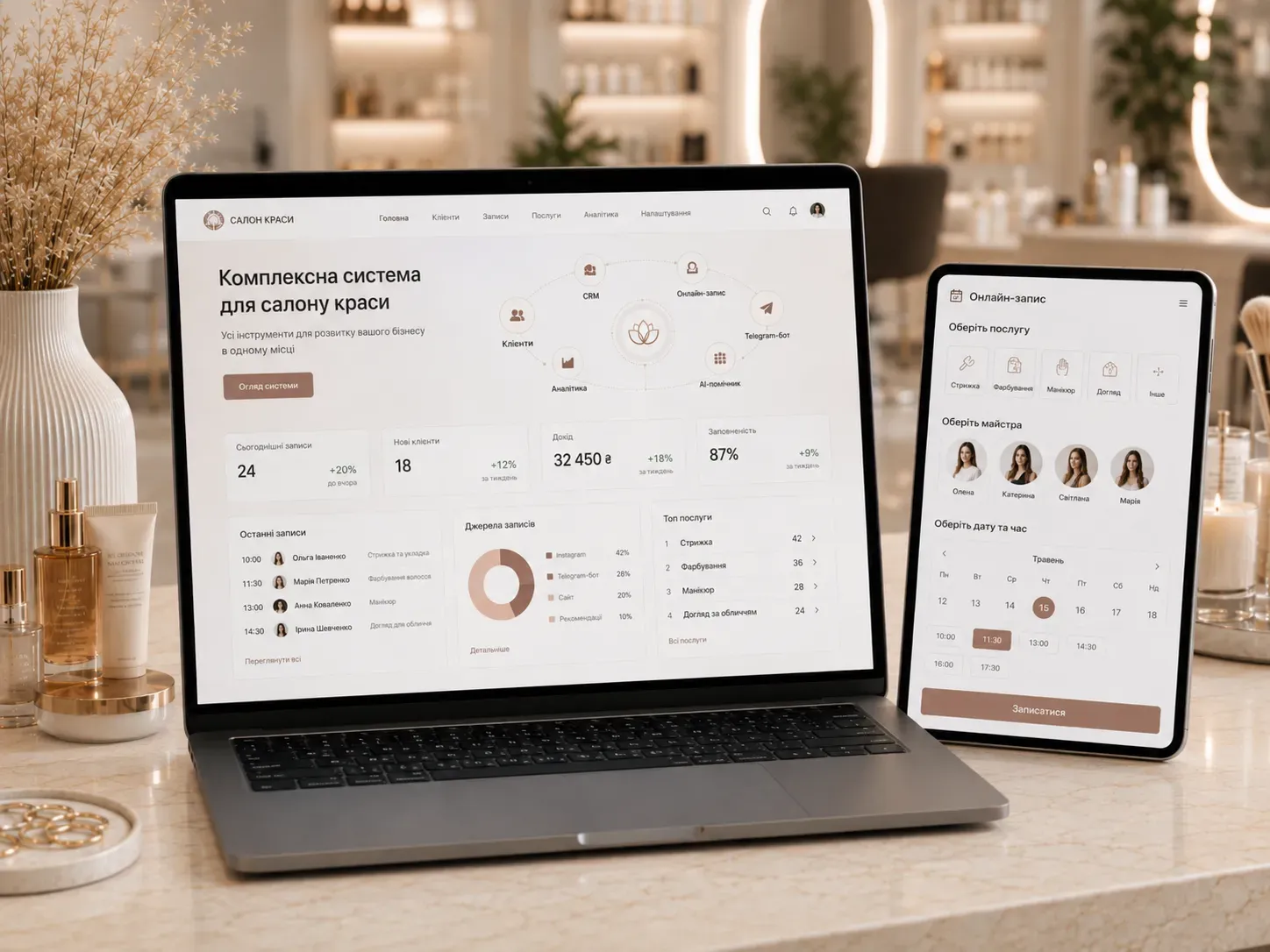
Beauty salon owners face typical challenges: clients forget about appointments, specialists work with scattered spreadsheets, marketing campaigns fail to deliver expected results, and manual operations consume administrators' time. All of this leads to lost sales, reduced average checks, and inefficient resource use.
The solution to these problems is a comprehensive digital ecosystem that combines a website, CRM, Telegram bot, AI, and automation. Such a system functions as a single organism: attracting new clients, simplifying booking, serving without delays, re-engaging those who forgot about visits, and providing the owner with full control over the business.
Why a Beauty Salon Needs a Comprehensive System
Using separate tools—a website without CRM, a Telegram bot without AI, spreadsheets instead of automation—creates gaps in client experience and business processes. Here are some examples:
- A client booked an appointment on the website, but the administrator didn’t receive a notification and didn’t confirm the booking. The client waits and then goes to a competitor.
- A specialist tracks services in a notebook, forgets important details or loses records. As a result—errors in work and dissatisfied clients.
- The salon launches a promotion, but doesn’t track its effectiveness. Money is spent, but the result is unclear.
- A client doesn’t return after the first visit because the system didn’t remind them about the next appointment or offer a personalized discount.
These issues are resolved by a unified system where each tool complements the others. For example, the website attracts clients, the CRM records their data and history, the Telegram bot automatically reminds them about appointments, and AI analyzes behavior and offers personalized promotions.
Architecture of a Digital Ecosystem for a Beauty Salon
A comprehensive system for a beauty salon consists of several key components that interact with each other. Let’s examine their roles and functions:
1. Website: Showcase and First Point of Contact
A website is not just an online business card—it’s a tool for attracting and converting clients. It should be:
- Fast and responsive: users won’t wait for loading, especially on mobile devices.
- Easy for booking: an online calendar with available slots for specialists should be visible and simple to use.
- SEO-optimized: so clients can find the salon through search engines with queries like “manicure in Kyiv” or “best massage in Lviv.”
- Integrated with CRM and Telegram bot: data from the booking form automatically goes into the CRM, and the client receives confirmation via the bot.
Example website structure:
- Homepage with promotions and popular services.
- Services page with descriptions, prices, and booking options.
- Blog with care tips and salon news (for SEO and attracting organic traffic).
- Client portal for viewing visit history and bookings.
2. CRM: Center for Client and Business Management
CRM (Customer Relationship Management) is the core of the system, where all client data, their visits, and sales analytics are stored. Key CRM functions for a beauty salon:
- Client database management: recording contacts, service history, specialist notes, and client preferences.
- Online booking: a calendar with available slots for each specialist, integrated with the website and Telegram bot.
- Automatic reminders: SMS, email, or messenger notifications about upcoming visits.
- Client segmentation: dividing clients into groups based on visit frequency, spending, or other criteria for personalized offers.
- Analytics and reporting: tracking key metrics such as average check, specialist workload, and promotion conversion.
- Integration with payment systems: for automatic payment tracking and reporting.
Example of CRM in action: A client books a massage via the website. The system automatically adds them to the database, assigns a specialist, sends confirmation via Telegram bot, and reminds them about the appointment 24 hours before the visit. After the visit, the client receives an offer to leave a review or book the next procedure with a discount.
3. Telegram Bot: Automatic Assistant for Clients and Administrators
A Telegram bot is a convenient communication channel with clients that works without administrator involvement. Key bot functions for a beauty salon:
- Online booking: clients can choose a service, specialist, and available slot directly in the messenger.
- Confirmation and reminders: the bot automatically sends booking confirmations and visit reminders.
- Service payments: integration with payment systems for quick payment directly in Telegram.
- Personalized offers: the bot analyzes a client’s history and suggests promotions or services they might be interested in.
- Review collection: after a visit, the client receives a request to leave a review or rate the service.
- Quick answers to questions: the bot can answer common questions (e.g., about working hours, service prices, or salon address).
Example of interaction with the bot: A client messages the bot: “Book a manicure.” The bot offers to choose a specialist, date, and time. After selection, the client receives confirmation and the option to pay for the service online. A day before the visit, the bot reminds them about the appointment and suggests adding a pedicure with a discount.
4. AI: Smart Analysis and Personalization
Artificial intelligence (AI) enhances system efficiency by analyzing data and automating routine tasks. Key AI applications for a beauty salon:
- Personalized offers: AI analyzes a client’s history and suggests services or promotions they’re likely to be interested in.
- Churn prediction: the system identifies clients who rarely visit the salon and automatically sends them motivational offers.
- Automatic review classification: AI analyzes client reviews and highlights key themes (e.g., “fast service” or “inconvenient schedule”).
- AI chatbot: an intelligent assistant that answers complex client questions and helps choose services.
- Specialist schedule optimization: AI analyzes specialist workload and suggests optimal slot distribution for maximum efficiency.
Example of AI in action: A client usually visits the salon once a month but has been doing so less frequently lately. AI detects this trend and sends the client a personalized offer: a discount on the next visit or a free additional service.
5. Automation: Eliminating Manual Work
Process automation frees up time for administrators and specialists to focus on more important tasks. Key processes that can be automated in a beauty salon:
- Service booking: clients independently choose a specialist and time, and the system automatically records the booking in the CRM.
- Visit reminders: SMS, email, or Telegram notifications are sent automatically a day before the appointment.
- Invoice and receipt sending: after payment, the client receives an electronic receipt via email or messenger.
- Review collection: after a visit, the client automatically receives a request to leave a review or rating.
- Promotion and offer distribution: the system segments clients and sends them personalized offers.
- Reports and analytics: daily or weekly reports are sent to the owner with key business metrics.
Example of automation: A client books a haircut via the website. The system automatically:
- Records the booking in the CRM.
- Sends confirmation via Telegram bot.
- Reminds the client about the appointment a day before the visit.
- After the visit, sends a request for a review.
- A week later, offers to book the next haircut with a discount.
How the Unified System Architecture Works
All system components—the website, CRM, Telegram bot, AI, and automation—work together as a single mechanism. Here’s how it happens in practice:
- Client attraction: the website and SEO bring in new clients, while promotions in Telegram and on the site motivate them to book.
- Service booking: clients can book via the website, Telegram bot, or by calling the administrator. All data automatically goes into the CRM.
- Service delivery: specialists see the schedule in the CRM, and clients receive reminders and instructions via the bot.
- Client re-engagement: AI analyzes client behavior and sends them personalized offers for repeat visits.
- Analytics and management: the owner receives reports on key business metrics and can make data-driven decisions.
Example Scenario from First Contact to Loyal Client
- A client searches for “massage in Kyiv” and lands on the salon’s website via Google search. On the site, they see a promotion “First massage with a 20% discount” and proceed to online booking.
- The client chooses a service, specialist, and available slot. The data automatically goes into the CRM, and the client receives confirmation via Telegram bot.
- A day before the visit, the bot reminds them about the appointment and offers to add aromatherapy with a discount.
- After the visit, the client receives a request to leave a review and an offer to book the next massage with a 10% discount.
- AI analyzes the client’s behavior and a month later sends them a personalized offer for a hot stone massage.
- The client becomes a regular, and the salon owner sees their history in the CRM and can offer even more personalized services.
Stages of Implementing SwiftyFlux’s System
Implementing a comprehensive system for a beauty salon happens in stages. Here’s how SwiftyFlux does it:
Stage 1: Business Process and Requirements Analysis
- Meeting with the owner to identify key needs and problems.
- Analyzing current tools and processes (e.g., how client records are kept, how booking is done).
- Defining implementation goals: increasing the number of clients, improving loyalty, reducing manual work, etc.
Stage 2: System Design
- Developing the system architecture: which components will be included (website, CRM, Telegram bot, AI, automation).
- Defining functional requirements for each component.
- Creating a technical specification and interaction scheme between tools.
Stage 3: Development and Configuration
- Website: design development, layout, online booking setup, and CRM integration.
- CRM: configuring the client database, booking calendar, automatic reminders, and reports.
- Telegram bot: developing interaction scenarios, integrating with CRM and payment systems.
- AI: setting up personalization algorithms, review analysis, and churn prediction.
- Automation: configuring processes such as reminders, review collection, and promotion distribution.
Stage 4: Testing and Training
- Testing the system on real scenarios: client booking, service payment, reminders, etc.
- Staff training: how to use the CRM, work with the Telegram bot, and analyze reports.
- Error correction and improvements based on feedback.
Stage 5: Launch and Support
- System launch.
- Technical support and maintenance during the first months.
- Monitoring key metrics and optimizing the system to achieve set goals.
Benefits of a Comprehensive System for a Beauty Salon
Implementing a unified digital ecosystem brings a beauty salon several advantages:
| Problem Before Implementation | Result After Implementation |
|---|---|
| Clients forget about appointments and don’t show up | Automatic reminders via Telegram bot and SMS reduce missed appointments by 70-90% |
| Manual client and service tracking in spreadsheets | CRM automatically records all data, eliminates errors, and reduces administration time |
| Low conversion of promotions and offers | AI and client segmentation increase marketing campaign effectiveness by 2-3 times |
| Lack of repeat sales | Personalized offers and loyalty programs increase visit frequency by 30-50% |
| Inefficient specialist schedules | Schedule optimization with AI and analytics increases workload by 20-40% |
| Difficulties in collecting reviews and analyzing data | Automatic review collection and CRM reports simplify service quality assessment and business management |
How to Choose a System for a Beauty Salon: Practical Criteria
Not every system is suitable for a specific beauty salon. Here’s what to consider when choosing a solution:
-
Component integration: the system should combine a website, CRM, Telegram bot, and AI into a single whole. If tools work separately, it creates additional difficulties.
-
Flexibility and customization: the system should adapt to your business processes, not the other way around. For example, if you have a non-standard specialist schedule, the CRM should support it.
-
Client convenience: clients should easily book services, receive reminders, and communicate with the salon without extra effort.
-
Staff convenience: the CRM and other tools should be intuitive for administrators and specialists to avoid spending time on training.
-
Analytics and reporting: the system should provide clear reports on key business metrics such as average check, specialist workload, and promotion conversion.
-
Technical support: it’s important that the development team provides fast and quality support if questions arise.
-
Cost and ROI: evaluate the system’s cost and expected return on investment. For example, if the system costs 50,000 UAH per year but increases revenue by 300,000 UAH through repeat sales and schedule optimization, it will pay off.
Conclusion
A comprehensive system for a beauty salon that combines a website, CRM, Telegram bot, AI, and automation is not a luxury but a necessity for a modern business. It allows:
- Attracting more clients through the website and SEO.
- Simplifying the booking process and eliminating manual work.
- Increasing client loyalty with personalized offers and automatic reminders.
- Optimizing specialist schedules and increasing salon workload.
- Making decisions based on data, not intuition.
SwiftyFlux develops such systems turnkey, considering the specifics of your business and goals. We don’t just implement tools—we create a unified digital ecosystem that works for results.
If you’re ready to move from separate tools to a comprehensive beauty salon management system, contact SwiftyFlux. We’ll help automate processes, attract more clients, and increase your business’s profitability.
Ready to automate your beauty salon?
SwiftyFlux develops comprehensive digital ecosystems for beauty salons turnkey. We’ll combine a website, CRM, Telegram bot, AI, and automation into a unified system that will work for your business. Leave a request, and our manager will consult you on the optimal solution for your salon.
FAQ
How long does it take to implement a comprehensive system for a beauty salon?
The timeline depends on the system’s complexity and the number of components. Typically, development and implementation take from 2 to 6 months. For example, creating a website with online booking and CRM integration can take 1-2 months, while adding a Telegram bot and AI may take another 1-2 months.
Is staff training required to work with the new system?
Yes, staff training is an important part of implementation. However, modern CRMs and Telegram bots are intuitive, so training usually takes no more than a few hours. SwiftyFlux provides detailed instructions and conducts training for administrators and specialists.
Can the new system be integrated with existing tools?
Yes, we analyze the salon’s current tools and processes and develop the system to integrate with them. For example, if you already have a client database in Excel, we’ll transfer it to the CRM. If you use a specific payment system, we’ll integrate it with the website and Telegram bot.
How does AI help a beauty salon?
AI analyzes client data and behavior to offer personalized services and promotions. For example, if a client usually visits the salon once a month but has been doing so less frequently lately, AI detects this trend and offers them a motivational discount. AI can also analyze client reviews and highlight key themes for service improvement.
Is it safe to store client data in a CRM?
Yes, client data security is our priority. We use modern encryption and data protection technologies and comply with legal requirements for personal data protection. Additionally, only authorized personnel with appropriate roles and permissions have access to the CRM.
How to measure the effectiveness of a comprehensive system?
The system’s effectiveness can be measured by several key metrics: - Increase in the number of clients and repeat visits. - Reduction in missed appointments. - Increase in the average check. - Specialist workload. - Conversion of marketing campaigns. The CRM provides detailed reports on these metrics, allowing you to evaluate the return on investment and optimize business processes.