LMS for Fitness Clubs: Training Coaches, Administrators, and Managers
How a learning management system (LMS) for fitness clubs reduces onboarding time, standardizes service across all locations, and improves the qualifications of coaches, administrators, and managers. A practical guide to online courses, tests, certification, and staff training.
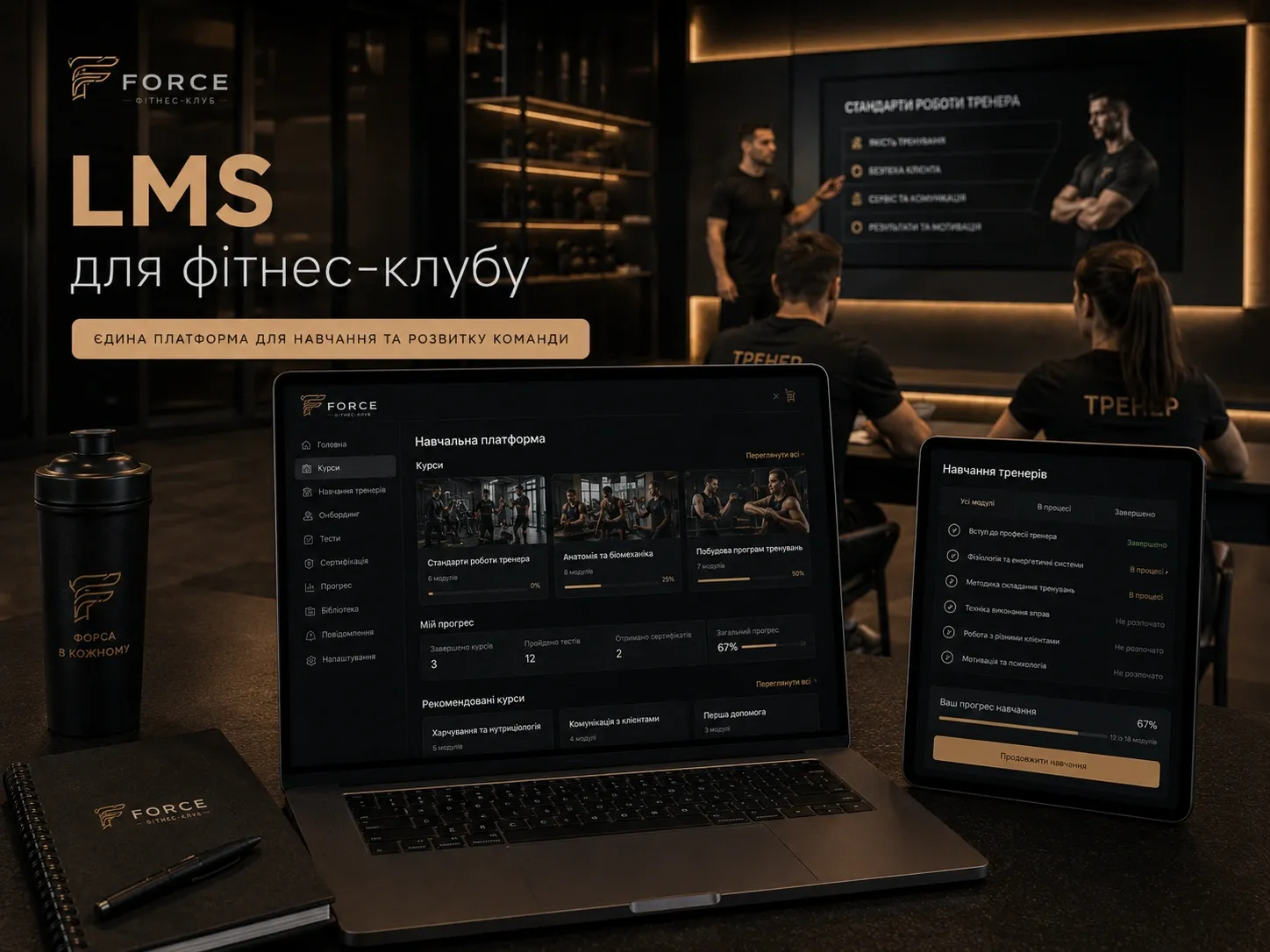
In a fitness club network with multiple locations, training a new coach can take anywhere from 2 weeks to 3 months. During this time, administrators spend hours on personal instruction, methodologists rewrite the same materials for each branch, and mistakes in staff performance lead to negative client feedback and reputational losses.
The problem isn’t the team’s qualifications—it’s the lack of a unified training system. Without one:
- Each new club starts from scratch: service standards, safety techniques, and training methodologies are interpreted differently.
- Onboarding depends on individuals: if a methodologist leaves, their replacement spends months restoring processes.
- Lack of progress tracking means some staff fail certification but continue working with clients.
The solution is a corporate LMS (Learning Management System) for fitness clubs. It allows centralizing training, making it transparent and measurable, while reducing onboarding time by 40–60%.
Why Fitness Club Networks Need an LMS
1. Consistent Standards Across All Locations
In a large network, each location has its own specifics: different equipment, schedules, and client bases. However, service standards, safety techniques, and training methodologies must remain consistent. For example:
- How a coach should greet clients at the reception.
- What questions to ask during an initial consultation.
- How to correct exercise techniques to avoid injuries.
Without an LMS, these standards are passed verbally or via PDF files, which are often lost or ignored. In a learning platform, all materials are stored in one place, accessible online, and updated centrally.
Example: If the network changes its sanitation protocol for equipment, updating a single lesson in the LMS will notify all employees to retake the training.
2. Reducing Onboarding Time
Traditional onboarding for a new coach includes:
- In-person meetings with a methodologist.
- Shadowing experienced colleagues.
- Studying internal documentation.
This process consumes significant administrative time and doesn’t guarantee that the new employee has absorbed all the information. With an LMS, part of the training can be moved online:
- Video lessons on safety techniques and service standards.
- Tests after each module to verify knowledge.
- Interactive checklists for independent work.
Result: A new coach can study basic materials before starting work in the gym, while in-person meetings with the methodologist focus on practical skills rather than theory.
3. Tracking Progress and Certification
Without an LMS, it’s difficult to track who has completed training and who hasn’t. Often:
- The methodologist assumes all coaches have reviewed new rules.
- In practice, some team members miss updates.
- During inspections, it’s discovered that standards aren’t being followed.
With an LMS, you can:
- Create mandatory courses with deadlines.
- Monitor each employee’s progress.
- Conduct regular certification with certificate issuance.
Example: After completing a safety course, a coach receives a certificate valid for 6 months. The system automatically reminds them to retake the training a month before expiration.
4. Training Different Staff Categories
Fitness clubs employ not only coaches but also administrators, managers, sales staff, and cleaners. Each group requires different knowledge:
| Staff Category | What to Train |
|---|---|
| Coaches | Training methodologies, safety techniques, service standards, client communication psychology |
| Administrators | CRM operations, membership sales algorithms, complaint handling, booking rules |
| Managers | Team management, sales analytics, club development strategy |
| Cleaners | Sanitation standards, equipment cleaning procedures, chemical safety |
An LMS allows creating separate courses for each group and assigning them based on the employee’s role.
How to Organize Training in an LMS for Fitness Clubs
Step 1: Define Key Training Modules
The LMS structure should reflect the club’s real processes. Typical modules for a fitness club:
-
Onboarding
- Corporate culture.
- Internal regulations.
- Safety techniques.
-
Service Standards
- Client communication algorithms.
- Conflict resolution.
- Visual standards (uniform, appearance).
-
Training Methodologies
- Anatomy and physiology basics.
- Exercise techniques.
- Individual programs for different client groups.
-
Equipment Handling
- Equipment usage rules.
- Sanitation procedures.
- Actions in case of breakdowns.
-
Sales and Client Relations
- Membership sales algorithms.
- CRM usage.
- Client retention techniques.
-
Certification
- Knowledge tests.
- Practical assignments.
- Certificate issuance.
Step 2: Choose Training Formats
Different formats can be used for each module:
- Video lessons – for demonstrating exercise techniques and client communication algorithms.
- Tests – for verifying theoretical knowledge.
- Interactive scenarios – for practicing skills in virtual situations (e.g., conflict resolution).
- Checklists – for self-assessment of readiness.
- Quizzes – for reinforcing material in a gamified format.
Example of a video lesson: A coach demonstrates an exercise technique on equipment, highlights common mistakes, and explains how to correct them.
Step 3: Set Up Certification
Certification should be mandatory for all employees and include:
-
Theoretical Part
- Multiple-choice tests.
- Open-ended questions to assess understanding.
-
Practical Part
- Video recordings of training (for coaches).
- Simulated client interactions (for administrators).
-
Certificate Issuance
- Automatic certificate generation after successful certification.
- Option to download certificates in PDF.
- Reminder system for certificate expiration.
Example of coach certification: A coach takes a safety test, records a video demonstrating training methodology, and receives a certificate valid for 1 year.
Step 4: Integrate LMS with Other Systems
For maximum efficiency, the LMS should be connected to other fitness club tools:
- CRM – to reflect training data in employee profiles.
- Access system – so new employees automatically gain club access after onboarding.
- Chatbots – for training reminders and deadlines.
Example of integration: If a coach misses the certification deadline, their club access is automatically blocked, and they receive a Telegram notification with a link to the course.
Step 5: Monitor Progress and Adjust
The LMS analytics module allows:
- Tracking each employee’s progress.
- Identifying weak spots in training (e.g., if most fail a specific test).
- Analyzing course effectiveness (time spent, success rates).
Example: If analytics show that 70% of coaches fail the safety test on the first attempt, additional video lessons can be added or the test can be divided into smaller parts.
How to Choose an LMS for a Fitness Club
Not all learning platforms are suitable for corporate training in the fitness industry. Key selection criteria:
| Criterion | What to Consider |
|---|---|
| Customization options | Can the platform be adapted to your standards and branding? |
| CRM and other system integrations | Are there APIs or ready-made integrations with your tools? |
| Mobile access | Is there a mobile app for on-the-go learning? |
| Video hosting | Does the platform support video uploads and playback? |
| Analytics and reporting | Can you track employee progress and course effectiveness? |
| Certification | Is automatic certificate issuance available? |
| Support for different roles | Can you create separate courses for coaches, administrators, and managers? |
| Technical support | Is there fast support from developers? |
Practical tip: Before choosing an LMS, conduct a pilot training with a small group of employees. This will help assess the platform’s usability and functionality.
Conclusion: LMS as a Scaling Tool
A corporate LMS for fitness clubs isn’t just a training platform—it’s a tool for standardization and business scaling. It allows:
- Reducing new staff onboarding time.
- Ensuring consistent service standards across all locations.
- Monitoring training progress and conducting regular certification.
- Lowering the risk of errors due to insufficient qualifications.
- Creating a transparent career development system for employees.
If you’re planning to open new clubs or improve your team’s qualifications, an LMS will be a reliable assistant in these processes.
For a custom LMS tailored to your business needs, consider working with developers experienced in creating learning platforms for corporate clients.
Need a Custom LMS for Your Fitness Club?
We develop learning platforms tailored to the fitness industry: from coach onboarding to certification. Get a solution that reduces training time and standardizes operations across all locations.
FAQ
Can an LMS be integrated with a fitness club’s CRM?
Yes, most modern LMS platforms offer APIs or ready-made integrations with popular CRM systems. This allows synchronizing employee training data with their CRM profiles, automatically updating certification information, and controlling access to club resources.
How often should courses in the LMS be updated?
Courses should be updated whenever service standards, safety techniques, training methodologies, or internal processes change. It’s also recommended to regularly review materials (e.g., every six months) for relevance and supplement them with new case studies.
Is an LMS suitable for a small fitness club with 5 employees?
Yes, even small clubs can benefit from implementing an LMS. It helps reduce onboarding time for new employees, ensures consistent work standards, and monitors training progress. For small teams, simpler and more affordable solutions with minimal features can be chosen.
How can employees be motivated to complete LMS training?
Motivation can be both material and non-material. For example, bonuses or promotions can be tied to successful course completion and certification. Gamification (rewards for achievements), public recognition (leaderboards), and integrating training into an employee’s career path are also effective.
Can an LMS be used to train fitness club clients?
Yes, some LMS platforms allow creating courses not only for employees but also for clients. For example, you can develop online training programs, nutrition courses, or video lessons on exercise techniques. This helps increase client loyalty and add value to your club.