
LMS for Beauty Salons: How to Train Masters and Administrators Online
How to standardize service quality in beauty salons, speed up onboarding of new employees, and scale your team without losing quality using a learning management system. A practical guide for owners of salon chains, beauty academies, and team leaders.
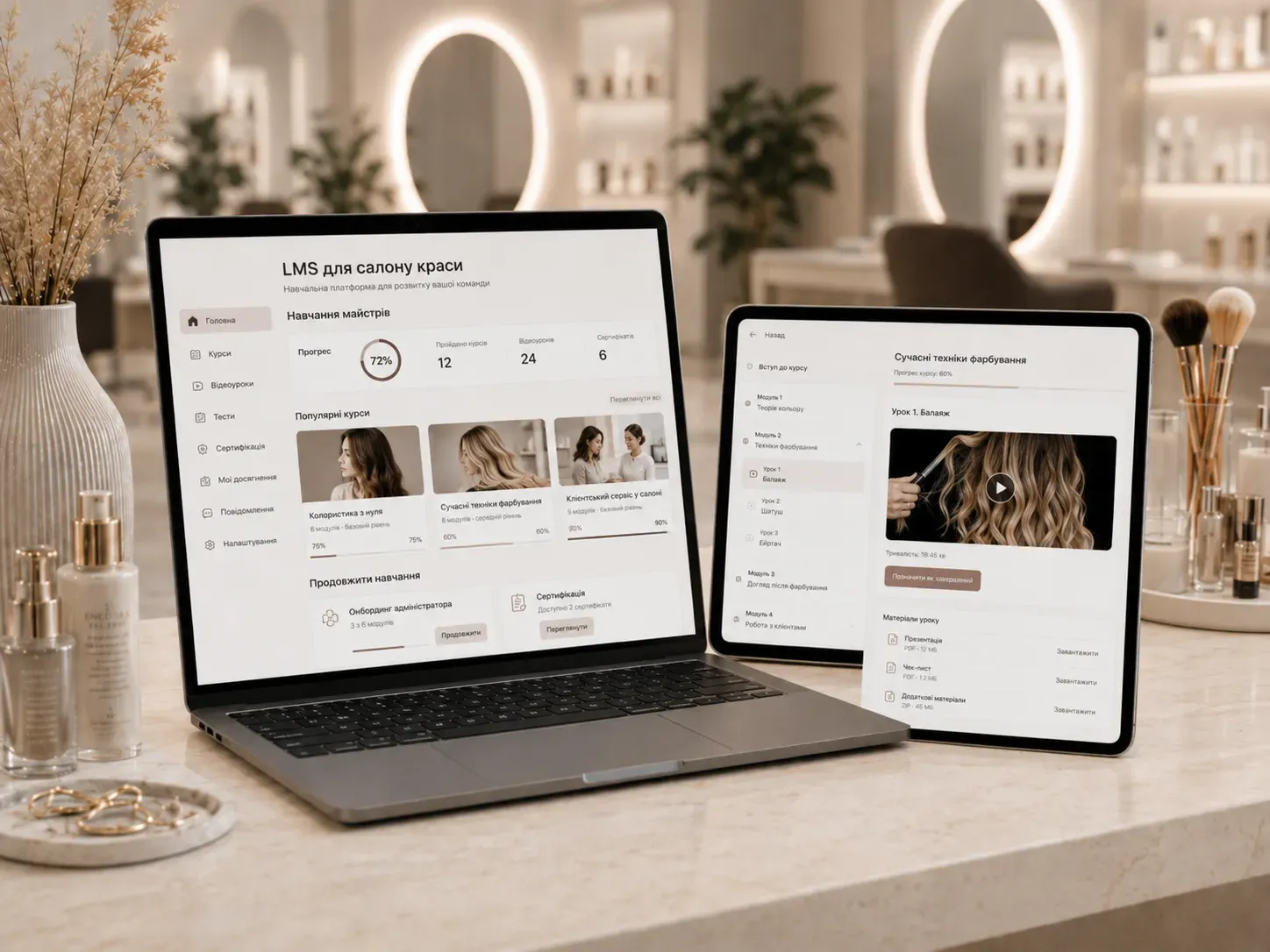
The success of a beauty salon depends not only on the quality of equipment or cosmetic brands but also on the level of team training. When masters and administrators work according to different standards, clients receive inconsistent service—differences in techniques, communication approaches, or even hygiene compliance. In salon chains, this problem becomes even more acute: each branch becomes an "island" with its own rules, complicating business scaling.
The solution is a corporate learning management system (LMS) that allows you to:
- standardize the knowledge and skills of the team;
- reduce the onboarding time for new employees;
- monitor training progress across all branches;
- automate certification and testing;
- reduce dependence on "star" trainers.
This article explores how to implement an LMS in a beauty salon to turn training from a one-time event into a continuous process that drives business results.
Why Beauty Salons Need Their Own LMS
1. The Problem of Standards: Why Clients Receive Different Experiences
In a beauty salon, each master is a separate brand. Some work with classic techniques, some experiment with new trends, and some simply "do as they know." The result? The same service provided by different masters (or even by the same master on different days) may vary in quality, duration, or even safety.
Examples of problems due to lack of standards:
- A client books a "buzz cut" but receives uneven lengths at the temples because masters use different attachments.
- An administrator doesn’t know all the nuances of the salon’s services and cannot properly consult clients over the phone.
- A new master doesn’t know how to properly disinfect tools, increasing the risk of infections.
Without a unified training system, each employee learns "as they can": some read instructions, some ask colleagues, and some rely on experience. This leads to mistakes that cost the salon its reputation and money.
2. Onboarding New Employees: How to Reduce Adaptation Time
On average, a new master takes 2–4 weeks to reach full productivity. During this period, the salon:
- pays a salary to an employee who isn’t yet fully productive;
- risks losing clients due to rookie mistakes;
- wastes the time of experienced colleagues on "mentoring."
Traditional onboarding looks like this:
- Introduction to the team and salon rules.
- Learning the service catalog and prices.
- Training on equipment and cosmetics.
- Observing experienced masters at work.
- First independent procedures under supervision.
The problem is that most of these stages depend on the human factor: if a mentor is busy, the newcomer waits. If the mentor doesn’t explain details, the newcomer doesn’t know them. If there are no written instructions in the salon, knowledge is lost with every employee who leaves.
3. Scaling the Network: How to Maintain Quality Across All Branches
When a salon becomes a chain, each new branch presents a new training challenge. If one salon has an experienced master who can train others, a new branch often has no one to pass on standards.
Typical scenarios in salon chains:
- A branch opens in another city, and a trainer must be dispatched from the central office.
- New employees in regions learn from those who recently joined themselves.
- Each branch interprets corporate standards in its own way.
Without a centralized training system, the chain risks losing control over service quality. Clients accustomed to the service level in one salon become disappointed in another.
How an LMS Solves These Problems
A corporate learning management system (LMS) is not just "video lessons on a website." It’s a comprehensive platform that allows you to:
| Problem | How an LMS Solves It |
|---|---|
| Lack of standards | A unified knowledge base for all employees, accessible at any time |
| Long onboarding | Structured courses with automated progress tracking |
| Dependence on trainers | Video lessons, tests, and certification without human involvement |
| Discrepancies between branches | Centralized training with uniform standards for all |
| Loss of knowledge upon employee departure | All materials are stored in the system regardless of personnel |
Let’s explore the key features of an LMS for beauty salons.
1. Onboarding: From Theory to Practice
Onboarding in an LMS consists of several stages, each of which can be automated:
Stage 1. General Salon Rules
- Video tour of the salon with explanations of zones and equipment.
- Interactive guide to internal regulations.
- Test on company policy knowledge (e.g., leave or confidentiality rules).
Stage 2. Learning Services and Products
- Video lessons for each service (execution technique, duration, contraindications).
- Instructions for working with cosmetics (composition, purpose, application features).
- Tests on the service catalog and prices.
Stage 3. Practical Skills
- Video demonstrations of procedures with expert commentary.
- Checklists for independent practice on mannequins.
- Homework with photo or video reports for mentor review.
Stage 4. Working with Clients
- Communication scripts with clients (how to answer questions, how to offer additional services).
- Video examples of correct and incorrect communication.
- Tests on service standards.
At each stage, the system tracks employee progress and doesn’t allow moving to the next module until the previous one is completed. This ensures consistency in training and eliminates gaps in knowledge.
2. Service Standards: How to Make Training Mandatory
For standards not to remain on paper, they must be:
- formalized as specific instructions;
- made accessible to the entire team;
- monitored for compliance.
How this is implemented in an LMS:
- Unified knowledge base: all instructions, techniques, and rules are stored in one place. For example, the standard for manicure includes step-by-step instructions with photos, videos, and checklists.
- Mandatory courses: for each position (master, administrator, manager), a list of courses to complete is defined. For example, an administrator must know all salon services, while a master must know the techniques for performing them.
- Regular updates: when new trends or products appear, courses are updated, and employees undergo retraining.
- Certification: after completing a course, the employee takes a test and receives a certificate. Without a certificate, they cannot provide certain services.
Example of a manicure standard:
- Preparing the workspace (tools, disinfection).
- Procedure stages (removing old coating, cuticle treatment, etc.).
- Working with different nail types (thin, brittle, problematic).
- Completing the procedure (applying oil, cream).
- Working with clients (consultation, care recommendations).
Each of these points is detailed in the system, and the master can review the instructions even during work.
3. Video Lessons: How to Train Without a Trainer
Video lessons are the foundation of LMS training. They allow you to:
- demonstrate procedure techniques in action;
- show correct and incorrect examples;
- save trainers’ time, who don’t have to repeat the same thing for every newcomer.
How to create effective video lessons:
- Short modules: each video focuses on one specific topic (e.g., "How to work with gel polish on brittle nails"). Duration: 5–10 minutes.
- High-quality visuals: close-ups of hands, tools, and the master’s face to demonstrate techniques.
- Audio commentary: explanations of each step of the procedure, references to theoretical materials.
- Subtitles: for better information retention.
Examples of video lessons for beauty salons:
- For masters: haircut techniques, hair coloring, massage, manicure, etc.
- For administrators: how to answer calls, consult clients, work with the cash register system.
- General courses: hygiene rules, safety techniques, client communication standards.
Video lessons can be supplemented with interactive elements:
- Pauses with questions ("Which tool should be used at this stage?").
- Quizzes after viewing ("What temperature should the autoclave be?").
- Ability to ask questions to the trainer directly under the video.
4. Tests and Certification: How to Control Knowledge
Without control, training becomes a formality. An LMS allows you to automate testing and certification of employees.
Types of tests:
- Entrance testing: assessment of the initial knowledge level of a new employee.
- Module tests: checking material absorption after each lesson.
- Interactive tasks: for example, identifying an error in a procedure technique from a photo.
- Final exams: comprehensive testing after completing a course.
How certification works:
- The employee completes the course and all tests with a minimum score.
- The system generates a certificate with the issue date and expiration term.
- The certificate is stored in the employee’s personal account and is available for management review.
- After the certificate expires, it needs to be renewed by undergoing retraining.
Example of a test for a manicure master:
- What temperature should the dry heat sterilizer be for tool sterilization?
- a) 120°C
- b) 180°C
- c) 240°C
- What product is used to remove cuticles in a European manicure?
- a) Cuticle nippers
- b) Keratolytic product
- c) Cuticle knife
- How often should the water in the hand bath be changed?
- a) After each client
- b) Once a day
- c) Once a week
Tests can be made more complex by adding practical tasks:
- Uploading a photo of a procedure for technique evaluation.
- Answering a client’s question in a chat simulating a real situation.
5. Progress Monitoring: How to Track Training Across All Branches
In a salon chain, it’s important to have centralized control over employee training in all branches. An LMS provides tools for monitoring and analytics.
Features for management:
- Progress dashboard: an overview of all branches—who completed which courses, test results.
- Employee reports: detailed information on each employee—completed courses, test scores, obtained certificates.
- Branch comparison: analysis of which salons have better-trained teams and where problems exist.
- Automatic reminders: the system sends emails or notifications to employees who haven’t completed training and their managers.
Example of a report for management:
| Branch | Number of Employees | Courses Completed | Average Test Score | Percentage Certified |
|---|---|---|---|---|
| Kyiv | 15 | 45 | 87 | 93% |
| Lviv | 10 | 25 | 72 | 60% |
| Odesa | 8 | 30 | 91 | 100% |
Such reports help quickly identify problems and take action. For example, if a branch has low test scores, additional training can be organized or the trainer can be replaced.
6. Training Employees Across Different Branches: How to Synchronize Knowledge
In a salon chain, the LMS becomes a single source of knowledge for all branches. This allows:
- ensuring the same service level regardless of location;
- quickly implementing new services or standards;
- reducing dependence on "key" employees.
How to organize training in branches:
- Centralized content creation: courses are created at the head office and automatically made available to all branches.
- Local adaptations: if a region has specific features (e.g., local laws or popular services), local modules can be added.
- Uniform testing standards: all employees take the same tests, ensuring objective evaluation.
- Regular updates: when standards change or new products appear, courses are updated for all branches simultaneously.
Example of implementing a new service in a chain:
- The head office creates a course on the new service (video lesson, instructions, test).
- The course is added to the mandatory list for all masters.
- The system sends notifications to employees about the need to complete training.
- After completing the course, masters receive a certificate and can provide the new service.
- Branch managers receive reports on training progress.
This approach allows implementing a new service in all salons within a few weeks without the need to dispatch trainers.
How to Choose an LMS for a Beauty Salon
Not every learning platform is suitable for a beauty salon. Here are the key selection criteria:
1. Course Creation Capabilities
- Support for video lessons with the ability to upload custom videos.
- Interactive elements (tests, quizzes, homework).
- Ability to create different types of content (text, images, video, PDF).
2. Testing and Certification System
- Different test types (multiple-choice, text input, file upload).
- Automatic certificate generation with company branding.
- Ability to set certificate expiration terms.
3. Progress Monitoring
- Dashboard for management with filtering by branches and employees.
- Reports with detailed information on each employee.
- Automatic reminders about incomplete training.
4. Integrations with Other Systems
- Synchronization with CRM for automatic employee enrollment in courses.
- Integration with HR systems to track employee training.
- Ability to connect payment systems for monetizing courses (if training external masters is planned).
5. Mobile Access
- Adaptive design for viewing courses on smartphones.
- Ability to learn offline (e.g., on a train).
- Push notifications about new courses and reminders.
6. Cost and Scalability
- Fixed price or per-user payment.
- Ability to add new courses and employees without limitations.
- Technical support and administrator training.
Practical Recommendations for Implementing an LMS
Implementing a learning platform is not a one-time event but a process that requires planning. Here’s a step-by-step plan for a beauty salon:
Step 1. Define Implementation Goals
- What problems need to be solved? (e.g., service standardization, reducing onboarding time).
- What results are expected? (e.g., reducing client complaints by 30%).
- Which courses are needed first? (e.g., hygiene standards, manicure techniques).
Step 2. Choose a Platform
- Compare several LMS based on the criteria from the previous section.
- Try demo versions and test capabilities.
- Consult with the technical department on integrations with existing systems.
Step 3. Create Content
- Film video lessons for key procedures.
- Develop instructions and checklists.
- Create tests for each course.
- Prepare certificates.
Tip: For the first courses, you can use existing materials (e.g., training recordings), but over time, they will need to be updated and expanded.
Step 4. Train Administrators
- Conduct training for HR and branch managers on working with the LMS.
- Explain how to create courses, check tests, and analyze reports.
- Develop instructions for administrators.
Step 5. Launch a Pilot Project
- Select one branch or group of employees for system testing.
- Gather feedback and fix issues.
- Evaluate training effectiveness using tests and feedback.
Step 6. Scale Across All Branches
- Gradually add new courses and employees.
- Monitor progress and adjust training.
- Regularly update content.
Conclusion
A corporate learning management system is not a luxury but a necessity for a modern beauty salon, especially if it’s a chain. It allows you to:
- standardize service and team knowledge;
- reduce onboarding time for new employees;
- monitor training quality across all branches;
- automate testing and certification;
- reduce dependence on individual trainers.
Implementing an LMS is an investment that pays off through:
- fewer mistakes and client complaints;
- increased employee productivity;
- the ability to quickly scale the business.
If you’re still training your team the "old way"—through training sessions, paper instructions, and colleague advice—it’s time to change your approach. Modern technology makes training more effective, transparent, and manageable.
Start small: choose one problem (e.g., onboarding new masters) and create a course for it in the LMS. Gradually expand the system by adding new modules and integrating it with other business processes. This way, you can build a team that works according to unified standards, regardless of which branch or city the employee is in.
Need an LMS for Your Beauty Salon?
SwiftyFlux develops custom learning platforms for beauty businesses from scratch. We consider all your requirements: from design to CRM integrations. Learn how to automate team training and standardize service across all branches.
FAQ
Can an LMS be used not only for masters but also for administrators?
Yes, a learning platform is suitable for all categories of salon employees: masters, administrators, managers, cosmetologists, etc. For each position, you can create separate courses with relevant topics and standards.
How much time does it take to create a course in an LMS?
The time depends on the course’s complexity. For example, a simple course on hygiene rules can be created in 1–2 days (filming a video, creating a test, preparing a certificate). A comprehensive course on manicure techniques may take several weeks.
Do you need technical knowledge to work with an LMS?
Modern learning platforms are designed so that people without a technical background can use them. Creating courses requires only basic computer skills. As a rule, the LMS provider offers training and support.
How to encourage employees to use an LMS?
It’s important to explain the benefits of the learning platform to the team: easy access to materials, the ability to learn at their own pace, and a transparent knowledge assessment system. Training can also be made mandatory during onboarding or linked to bonuses and career growth.
Can an LMS be integrated with other salon systems?
Yes, most modern LMS support integrations with CRM, HR systems, payment services, and other business tools. This allows automating processes, such as enrolling employees in courses upon hiring or sending certificates to their personal CRM accounts.
How to evaluate the effectiveness of an LMS?
Effectiveness can be evaluated by several criteria: reduced onboarding time, improved test results, fewer client complaints, and increased employee productivity. It’s also useful to gather feedback from the team and clients.