
Hotel Offer Landing Page: SPA Weekend, Corporate Event, Wedding, or Vacation
How to create a landing page that sells hotel offers better than a general website. Structure, content, booking, pricing, and ad campaign analytics for maximum conversions.
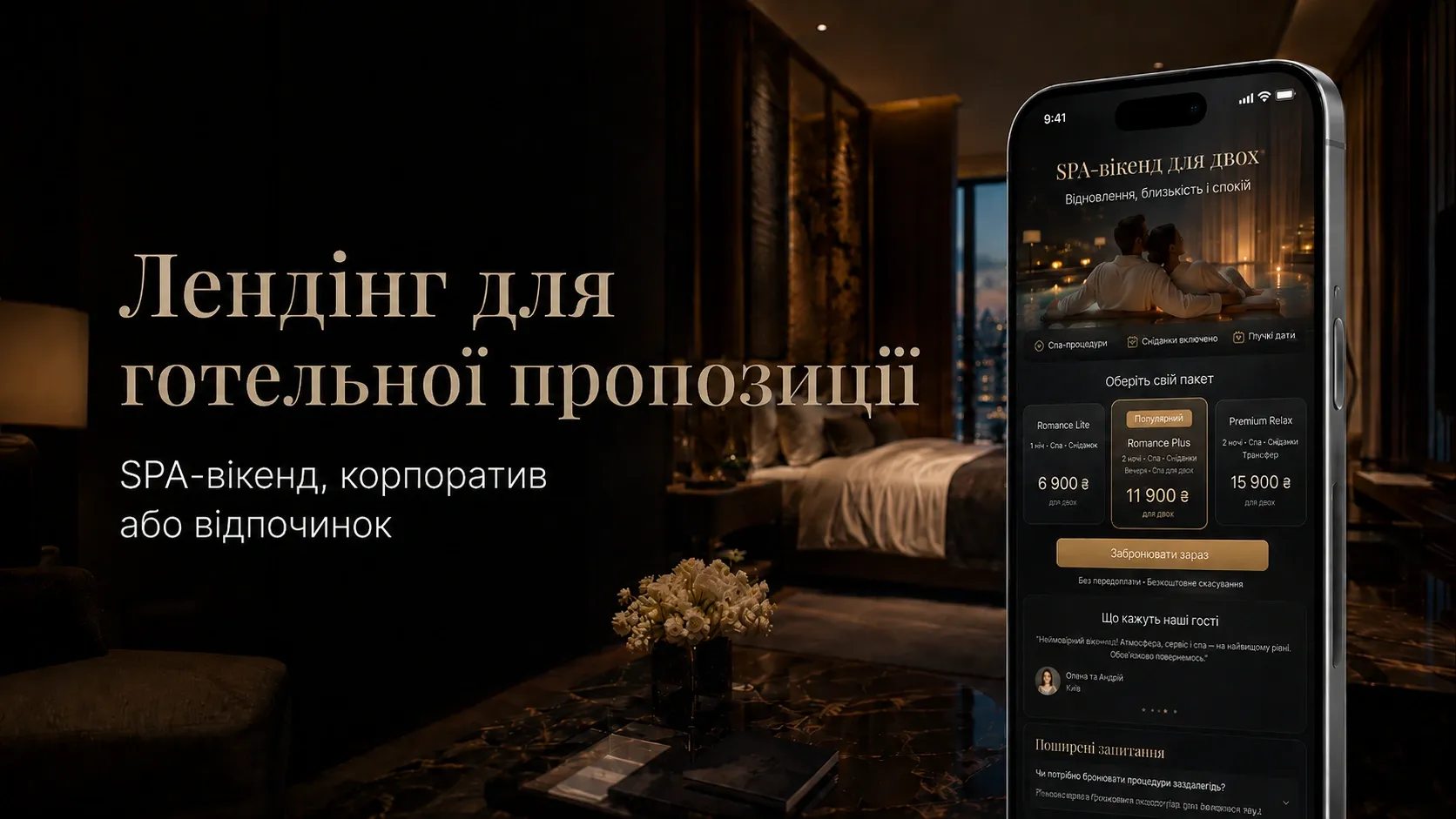
A general hotel website tells visitors about everything at once: rooms, services, location, and history. But when you launch a targeted offer—such as a SPA weekend, corporate event, wedding package, or seasonal vacation—this approach scatters the client’s attention. A dedicated landing page for a specific offer focuses attention on one value, simplifies the choice, and increases booking conversions.
In this article, we’ll cover:
- Why a general website loses to a landing page in selling package offers
- What structure a hotel offer landing page should have
- How to present the offer, photos, pricing, and the booking process
- Where to place social proof and how to work with FAQs
- How to integrate payments and track the effectiveness of advertising campaigns
Why a Landing Page Sells Better Than a General Hotel Website
A general hotel website is like a large shopping mall: the client gets lost among the assortment, doesn’t know what to choose, and often leaves without making a purchase. A landing page for a specific offer is like a specialized store where everything is tailored to one customer need.
Key advantages of a landing page:
- Focus on one value. The client sees not “rooms” but a “SPA weekend with unlimited access to the relaxation area.”
- Simplified choice. No extra options to distract from the booking decision.
- Higher conversion. The target audience sees exactly what interests them, without noise.
- Easier to test advertising. You can launch separate campaigns for each offer and accurately measure their effectiveness.
- Ability to use a strong offer. For example, “Book a wedding package by May 1 and get a free photoshoot.”
If your goal is to sell a specific offer, not just tell about the hotel, a landing page will be a more effective tool.
Structure of a Landing Page for a Hotel Offer
The optimal landing page structure consists of 7 key blocks. Each solves a specific task: attract attention, explain benefits, show social proof, eliminate doubts, and close the booking.
1. Hero Section
The first thing a visitor sees. It should include:
- Headline with clear value. For example: “SPA Weekend in the Carpathians: 2 Days of Relaxation for the Price of One.”
- Subheading with details. Briefly explain what’s included in the package.
- Photo or video. High-quality images of the relaxation area, rooms, or atmosphere.
- Booking button. Direct call to action: “Book the Weekend.”
Example:
Wedding Package “Fairytale Day” Wedding organization for 50 guests at a hotel with a banquet hall, photoshoot, and SPA relaxation for the newlyweds. [Book the Date]
2. Offer (Unique Proposition)
This block should answer the question: “Why should I choose this offer?”
Elements of a strong offer:
- List of included services. For example: “The price includes: accommodation in a luxury room, buffet breakfast, 3 hours in the SPA zone, transfer from the train station.”
- Time or quantity limitations. “Only until April 30” or “First 10 bookings.”
- Bonus. Free service or discount for those who book now.
Example:
Corporate Package “Effective Meeting”
- Accommodation in single rooms
- Banquet hall for 30 people with a projector
- Coffee break and lunch
- Team-building outdoors
- Bonus: Each participant receives a massage certificate
3. Photo Gallery
Visual content is one of the most powerful persuasion tools in the hotel industry. The client should imagine themselves in your space.
What to show in the gallery:
- Rooms or banquet halls (depending on the offer)
- SPA zone, pool, restaurant
- Atmospheric shots (e.g., a wedding ceremony on the hotel grounds)
- Reviews in photo format (e.g., a guest photo with a caption: “The best vacation of my life!”)
Tips:
- Use high-quality professional photos.
- Add captions to images (e.g., “Banquet hall for 100 people with panoramic views”).
- Optimize photo sizes for fast loading.
4. Pricing and Booking Conditions
This block should be as transparent and convenient as possible. The client shouldn’t have to search for price or condition information—everything should be visible.
What to include:
- Table with package options. For example:
| Package | Price (per person) | Included | Validity Period |
|---|---|---|---|
| SPA Weekend Standard | $95 | Accommodation, breakfast, 2 hours in SPA zone | Until 12/31/2024 |
| SPA Weekend Premium | $135 | Accommodation, breakfast, unlimited SPA access, private pool | Only in May |
| SPA Weekend Luxe | $190 | Accommodation, breakfast, unlimited SPA, transfer, massage | Limited quantity |
- Booking conditions. For example: “30% prepayment at booking, the rest on the day of arrival.”
- Cancellation policy. Whether cancellation is possible, the deadlines, and any penalties.
- Booking button. Direct call to action after reviewing the prices.
5. Booking Form
The form should be simple and not require unnecessary actions. Each additional field reduces conversion.
Optimal set of fields:
- First and last name
- Phone or email
- Check-in and check-out dates
- Number of people
- Package selection (if there are several)
- Comment (optional field)
Tips:
- Add a “Book Now” button with a clear call to action.
- Integrate a calendar for date selection (e.g., via Google Calendar or a custom interface).
- Connect online payment so the client can immediately make a deposit.
6. Social Proof
Reviews, ratings, and success stories increase trust in your offer.
What to use:
- Customer reviews. Real quotes with names and photos (if possible).
- Ratings. For example: “4.9/5 on Booking.com” or “95% of clients recommend us.”
- Case studies. Short stories about how clients spent time at your hotel (e.g., “How Company X held a corporate event at our complex”).
- Partner logos. If you collaborate with well-known brands or events.
Example review:
“We had our wedding at this hotel and loved it! Everything went perfectly: from the banquet to the photoshoot. We especially appreciated the professionalism of the event manager. Thank you!” — Anna & Oleksandr, Kyiv
7. FAQ (Frequently Asked Questions)
This block removes the last doubts of clients and reduces the load on your support service.
Example questions for FAQ:
- Can I change the booking date?
- Are alcoholic beverages included in the wedding package price?
- Is there parking for guests?
- Can I bring pets?
- What payment methods are available?
Tips:
- Use real questions that clients often ask.
- Answer briefly and clearly.
- Add links to detailed booking conditions.
8. Payment and Booking Confirmation
After filling out the form, the client should receive clear confirmation of their booking.
What to include in the payment process:
- Automatic confirmation. SMS or email with booking details.
- Payment instructions. What payment methods are available (card, cash, transfer) and how to make a deposit.
- Contact person. Name and phone number of the manager who will answer questions.
Tips:
- Integrate payment systems (LiqPay, WayForPay, Fondy) for fast online payments.
- Send a reminder to the client a day before arrival.
Advertising Campaign Analytics
A landing page is not just a page but a tool for measuring the effectiveness of your marketing efforts. Without analytics, you won’t understand what works and what doesn’t.
What to track:
- Traffic sources. From which channels visitors come (Google Ads, Facebook, Instagram, email newsletter).
- Conversion. How many visitors filled out the booking form.
- Cost per acquisition. How much one booking costs from a specific channel.
- Behavior on the page. Which blocks are viewed most often and where visitors leave the page.
Analytics tools:
- Google Analytics. For tracking traffic and behavior.
- Google Tag Manager. For setting up events (e.g., clicks on the booking button).
- Facebook Pixel. For tracking conversions from Facebook and Instagram ads.
- CRM system. For booking records and working with clients.
Example report:
| Traffic Source | Visitors | Conversion | Cost per Booking |
|---|---|---|---|
| Google Ads | 1,200 | 5% | $9.50 |
| 800 | 3% | $11.40 | |
| Email Newsletter | 500 | 10% | $3.20 |
How to use the data:
- Increase the budget for channels with the lowest cost per acquisition.
- Optimize the landing page for channels with low conversion.
- Test different offers and creatives to improve results.
Conclusion: The Landing Page as a Sales Tool
A general hotel website tells about you. A landing page for a specific offer sells. It focuses the client’s attention on one value, simplifies the choice, and increases booking conversions.
Key steps to create an effective landing page:
- Define the target audience and their needs.
- Develop a clear offer with limitations and bonuses.
- Create high-quality visual content.
- Make a transparent pricing table.
- Simplify the booking form and integrate online payment.
- Add social proof and FAQ.
- Set up analytics to track effectiveness.
A landing page is not a one-time campaign but a tool that can be continuously improved based on data. Test different headlines, offers, photos, and booking forms to find what works best for your audience.
Remember: the client doesn’t want to spend time searching for information. They want to immediately understand what you offer, how much it costs, and how to book. A landing page solves this task better than a general hotel website.
Need a Landing Page That Sells?
SwiftyFlux will create a high-conversion landing page for your specific hotel offer: from structure and design to booking integration and analytics. Increase the number of bookings today!
FAQ
How does a landing page differ from a general hotel website?
A landing page focuses on one specific offer (e.g., a SPA weekend or wedding package), while a general website covers all hotel services. This simplifies the choice for the client and increases booking conversions.
What elements must be included in a hotel offer landing page?
Essential elements include: a hero block with a clear offer, photo gallery, pricing table, booking form, social proof (reviews, ratings), and FAQ. It’s also worth integrating online payment and analytics to track effectiveness.
How to create an effective offer for a hotel proposal?
The offer should include a list of included services, time or quantity limitations (e.g., “only until April 30”), and a bonus for those who book now (e.g., free transfer or massage).
How to increase the conversion of the booking form?
Simplify the form: leave only necessary fields (name, phone, dates, number of people). Add a calendar for date selection and integrate online payment. Each extra field reduces conversion.
What tools to use for landing page analytics?
Use Google Analytics (traffic and behavior), Google Tag Manager (events), Facebook Pixel (ad conversions), and a CRM system (booking records). This will help track ad campaign effectiveness and optimize the landing page.
Can one landing page be used for multiple offers?
No, each offer should have its own landing page. This allows you to focus the client’s attention on one value and increase conversion. For example, a landing page for a SPA weekend won’t work for a corporate event.