
Personal Brand of a Fitness Trainer: Website, Positioning, and Leads from Google
How to create an asset — a website for a fitness trainer — to stop depending on gyms and social media algorithms. Step-by-step guide: niche selection, offer, portfolio of results, blog, online consultations, and local SEO.
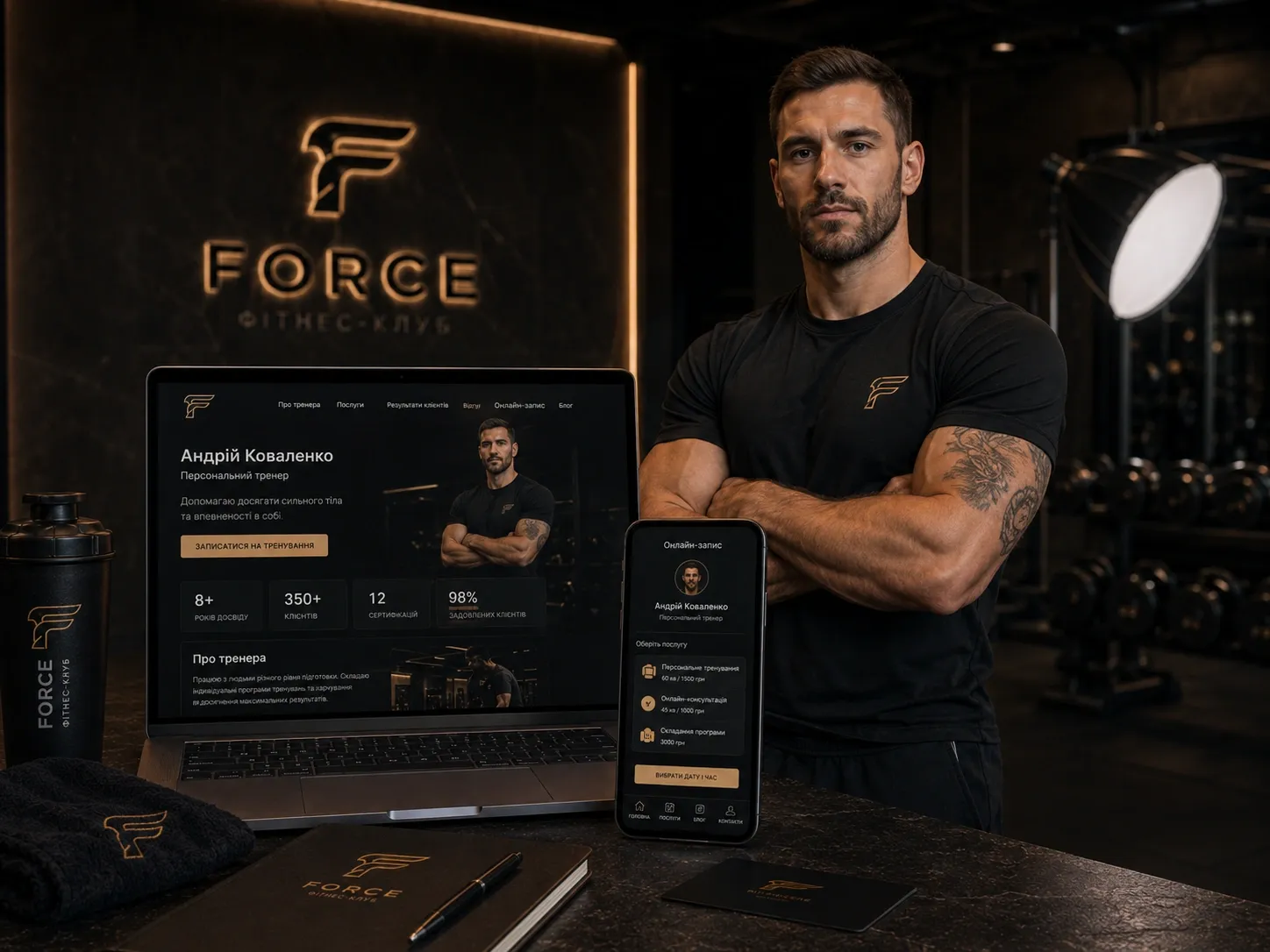
Why a Fitness Trainer Needs a Personal Website
You work in a gym or conduct online sessions, but every new client comes through Instagram or recommendations. Today, algorithms change, and tomorrow, the gym may alter collaboration terms. Dependence on a single platform is a business risk.
A personal website is an asset that:
- Works 24/7 without your involvement.
- Brings clients from Google even at night.
- Stores all data under your control.
- Allows selling services without commissions.
Without a website, you remain an "eternal employee" in the fitness world. With a website, you build a brand that generates leads even during vacations.
How to Choose a Niche and Position Yourself
Versatility is the enemy of conversion. If you’re "just a trainer," it’s hard to find you in search and even harder to remember.
Criteria for Choosing a Niche:
- Target Audience: Who is your ideal client?
- Examples: Women postpartum, men 40+ with back problems, teenagers with obesity, amateur athletes.
- Problem: What specific issue do you solve?
- Examples: Recovery after injury, competition preparation, weight loss without diets, posture correction.
- Work Format: Online, offline, hybrid?
- Examples: Personal training at home, online programs with daily support, group classes in the park.
How to Validate the Niche:
- Search Demand: Enter key queries in Google and check the volume of ads and organic results. Example: "online pilates instructor for beginners" vs "personal trainer Kyiv."
- Competitors: Study the websites of the top 5 trainers in your niche. What do they offer? What’s missing?
- Personal Experience: Do you have unique cases or methodologies? For example, rehabilitation after knee surgery using an author’s program.
Example of Positioning:
"I am a pilates instructor for women aged 30-45 who want to eliminate back pain without medication. I work online and in a studio in Lviv. Guaranteed results in 8 weeks or your money back."
Such a formulation:
- Filters out non-target clients.
- Increases trust through specific timelines.
- Allows selling more expensive programs.
Structure of a Website for a Fitness Trainer
An effective website consists of 5 key blocks, each responsible for its stage in the sales funnel.
1. Homepage (Hero + Values)
Goal: Capture interest in 5 seconds.
- Headline: Clearly states your uniqueness. Example: "Restore posture after childbirth — without pain or pills."
- Subheadline: Explains the mechanism. Example: "Author’s program based on clinical pilates with physiotherapist support."
- Call-to-Action Button: Leads to the main offer. Example: "Get a 7-day recovery plan."
- Social Proof: Testimonials or media logos. Example: "Recommended by 'Health' magazine."
2. Services and Offer
Goal: Convert interest into a lead.
- Package Offers: Instead of "Training session — 1000 UAH," better:
| Name | Duration | Price | Bonuses |
|---|---|---|---|
| "Ease of Movement" | 4 weeks | 4500 UAH | Video instructions as a gift |
| "Strong Core" | 8 weeks | 8000 UAH | Personal consultation with a dietitian |
- Guarantees: Reduce risk for the client. Examples: "Results in 28 days or money back," "First session free."
- Limitations: Create scarcity. Example: "Only 3 spots per month due to high-quality support."
3. Portfolio of Results
Goal: Prove expertise.
- Before/After: Client photos with permission (with captions like "Maria, 34, reduced back pain by 80% in 6 weeks").
- Case Studies: Detailed success stories.
Example:
"Olena came with complaints of chronic neck pain. In 12 weeks, we:
- Reduced pain syndrome by 90%.
- Restored shoulder joint mobility.
- Taught her to maintain results independently."
- Video Testimonials: The most convincing format.
4. Expert Blog
Goal: Attract clients from search and build trust.
- Article Topics:
- "How to choose a rehabilitation trainer after a knee injury."
- "5 mistakes in training with scoliosis."
- "Why does your back hurt after childbirth, and how to fix it."
- Formats:
- Step-by-step guides.
- Debunking myths.
- Personal client stories.
- SEO Optimization: Each article should answer a specific search query. Example: "How to get rid of lower back pain at home" instead of "Benefits of pilates."
5. Booking and Payment System
Goal: Automate sales.
- Online Booking: Integration with Google Calendar or specialized services (e.g., Calendly).
- Payment: Buttons for PayPal, WayForPay, Fondy, or bank acquiring.
Example:
"Choose a package → Fill out the form → Pay online → Get access to your personal account."
- Automated Funnels: Email notifications with training reminders and additional service offers.
How to Attract Clients from Google
Local SEO is the most effective channel for fitness trainers. Unlike social media, here clients actively search for you when they’re ready to pay.
Step 1: Optimize Google My Business
- Complete Your Profile 100%: Category ("Fitness Trainer," "Yoga Instructor"), working hours, studio/equipment photos.
- Collect Reviews: Ask clients to leave reviews via a link (e.g., NiceReply service).
- Post Updates: Announce group openings, promotions, useful tips.
Step 2: Keywords for the Website
Use tools like Google Keyword Planner or Ahrefs to analyze demand.
Examples of queries for different niches:
| Niche | Example Keywords |
|---|---|
| Personal Training | "personal trainer Kyiv price," "best functional training coach" |
| Yoga | "yoga instructor for beginners online," "prenatal yoga Lviv" |
| Rehabilitation | "trainer for recovery after spine injury," "fitness after knee surgery" |
| Pilates | "pilates for posture correction Kyiv," "online pilates course for women" |
Step 3: Technical SEO
- Loading Speed: The site should load in <2 seconds (check via PageSpeed Insights).
- Mobile Version: More than half of clients search for trainers via smartphone.
- Security: SSL certificate (https://) is mandatory.
- Local Links: Register in directories (e.g., tochka.net.ua) and on gym websites.
Step 4: Content Marketing
- Regularity: Publish 1-2 articles per month.
- Formats:
- Guides ("How to train with a herniated disc").
- Myth debunking.
- Client success stories.
- Distribution: Share links on social media and in newsletters.
Tools for Automation
To make the website work for you, not the other way around, use:
- CRM: For storing client data and automating communication.
- Examples: Pipedrive, HubSpot, Bitrix24.
- Email Marketing: For sending training programs and reminders.
- Examples: Mailchimp, SendPulse.
- Payment Systems: For automatic invoice generation.
- Examples: WayForPay, Fondy, LiqPay.
- Booking Systems: For online scheduling.
- Examples: Calendly, Setmore.
Example of a Real Trainer’s Website
Trainer: Pilates instructor for women 40+. Niche: Posture correction and back pain reduction. Website: 5 pages:
- Homepage (hero + testimonials + booking button).
- Services (packages for 4, 8, and 12 weeks).
- Blog (articles about pilates for osteochondrosis, home exercises).
- About Me (education, certificates, personal story).
- Contacts (booking form + online payment).
Results After 6 Months:
- 25+ clients from Google without ads.
- Average check increased from 1500 to 6000 UAH.
- Sales time reduced by 70% due to automation.
Common Mistakes and How to Avoid Them
| Mistake | How to Fix |
|---|---|
| Website without a clear offer | Formulate a unique proposition and place it prominently |
| No portfolio | Collect client photos and testimonials, publish them on the site |
| Ignoring SEO | Optimize the site for search queries, publish useful articles |
| No booking system | Integrate an online calendar and payment |
| Non-responsive site | Ensure the site is mobile-friendly |
| No blog | Write at least once a month on topics relevant to clients |
Conclusion
A personal brand for a fitness trainer starts with a website. This isn’t just a business card; it’s a tool for attracting clients, selling services, and building a long-term business. By investing time in niche selection, creating a portfolio, and optimizing for Google, you turn the website into an asset that works for you 24/7.
Start small: define your niche, create a simple 3-5 page website, and begin publishing useful content. Over time, add automation and scale your success.
Remember: every big brand started with one client and one website.
Ready to create a website that works for you?
At SwiftyFlux, we develop personal websites for fitness trainers that attract clients from Google and automate sales. From niche selection to launch — everything turnkey. Leave a request, and we’ll find the right solution for your business.
FAQ
How much does it cost to create a website for a fitness trainer?
The cost depends on the functionality. A basic business card website with 3-5 pages can be created for $400–$800. A full-fledged site with a blog, online booking, and payment starts from $1,100. Ready-made solutions on builders (Tilda, Wix) are cheaper but less flexible in customization.
Do I need SEO if I work only in one city?
Local SEO is the most effective way to attract clients in your city. By optimizing your site for queries like "personal trainer [city]," you can receive leads from clients ready to pay, without advertising.
How to convince clients to book online instead of messaging on Instagram?
Create a convenient booking system with instant payment and automated reminders. Add testimonials and guarantees to your site. Gradually move communication to a personal account on your site, offering exclusive content (video lessons, checklists) there.
How long does it take for the website to start bringing clients?
The first leads from Google may appear 2–3 months after launching the website and starting to publish useful content. If you already have clients, begin collecting testimonials and publishing them on your site — this will speed up the process.
How to choose a niche if I can work with different clients?
Start with the audience you’re most comfortable working with and where you have the best results. For example, if you’ve personally had back problems and successfully solved them, your niche could be "fitness for people with back pain." Versatility dilutes your brand, while a specific niche builds trust.