
AI for Fitness Clubs: Automating Sales, Support, and Customer Retention
How artificial intelligence helps fitness clubs automate gym membership sales, customer support, and churn prediction. Practical AI integration scenarios with CRM, websites, and messengers—without medical risks.
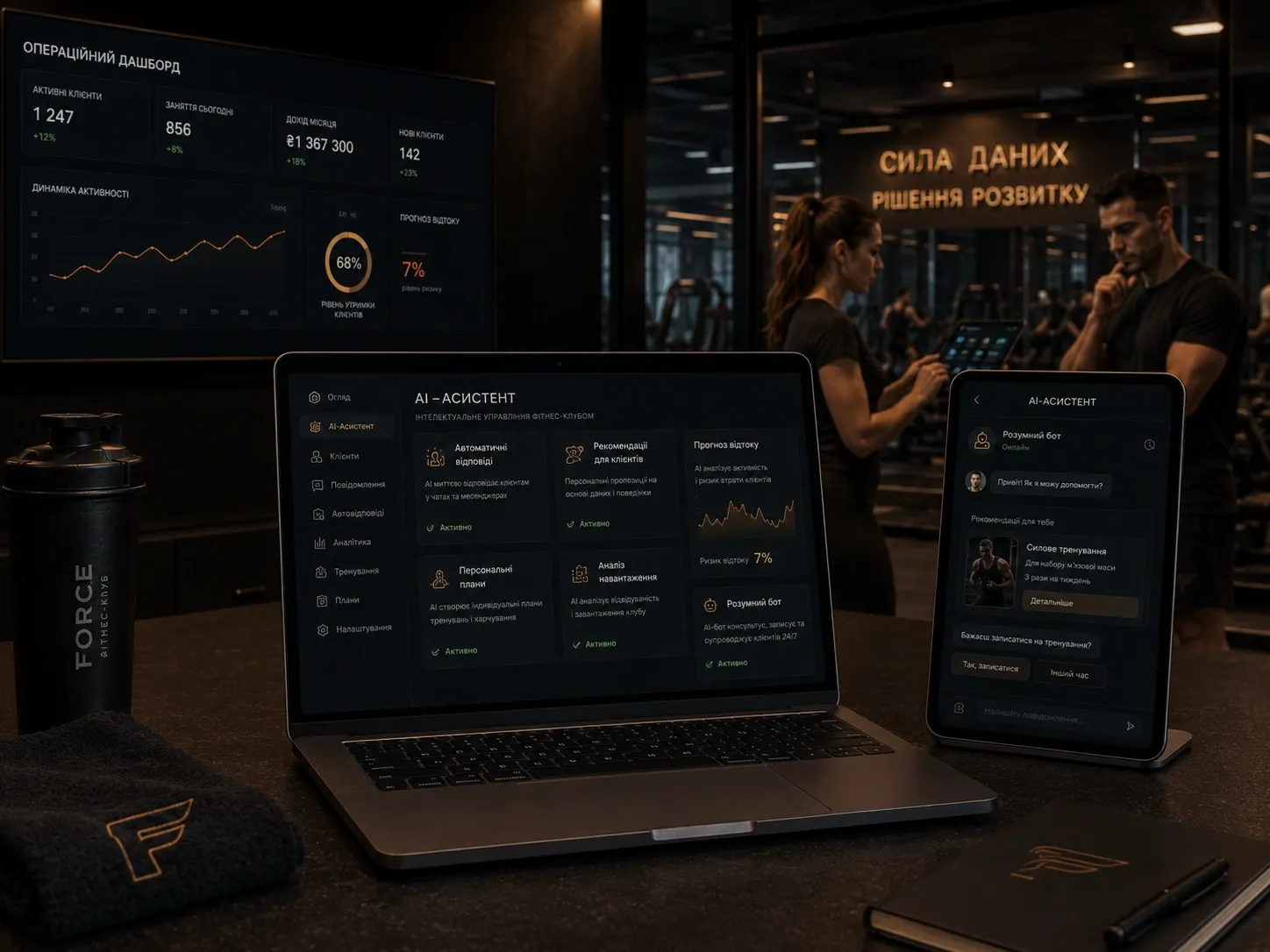
Fitness club owners face three common pain points:
- High costs of manual lead processing — Every call or message from a potential client requires a manager’s attention, delaying responses and reducing conversion rates.
- Low customer retention efficiency — Without analyzing visitor behavior, it’s hard to determine who is planning to leave and who is ready to renew their membership.
- Impersonal communications — Standard mailings don’t account for individual client needs, reducing their loyalty.
The result? Lost sales, increased churn, and inefficient resource use. AI can solve these problems—but only with proper integration, free from hype and risky recommendations.
Where AI Actually Works in Fitness Clubs (and Where It’s Just Hype)
Many companies promote AI as a universal solution, but not all scenarios are equally useful. Let’s break down which tasks can be safely automated and which require caution.
1. AI Consultant: Automating Responses to Common Questions
Scenario: A client messages via Telegram or the website: “How much does a membership cost?”, “What are the gym’s hours?”, “Is there parking?” The AI bot instantly provides an answer without involving a manager.
How It Works:
- Integration with CRM allows the bot to see the client’s history (e.g., whether they’ve purchased a membership before).
- Responses are generated based on pre-approved templates.
- If a question is atypical (e.g., “Can I bring a child?”), the bot redirects it to a manager.
Integration Examples:
- Telegram bot — Processes requests via messenger, integrated with CRM (e.g., Bitrix24 or AmoCRM).
- Website chat — AI consultant operates 24/7, answering visitor questions.
Limitations:
- AI can’t replace humans in complex queries (e.g., complaints about a trainer).
- The bot must never provide medical advice (e.g., “Which exercises are safe for a hernia?”).
2. Lead Qualification: How AI Identifies Potential Clients
Scenario: AI analyzes website or social media visitor behavior to determine who is ready to purchase a membership and who is just browsing.
How It Works:
- Website behavior analysis: If a user views the pricing page, leaves contact details, or adds a product to the cart, AI flags them as a “hot lead.”
- Query responses: If a client asks about membership terms, AI automatically prioritizes them for a manager’s call.
- Behavior-based segmentation: For example, clients who visited the site more than 3 times in a week receive personalized offers.
Example: A client fills out a website form asking for a callback. AI analyzes their data (age, interests, past purchases) and passes it to the manager with a note: “High purchase probability. Offer a 6-month membership.”
3. Personalized Recommendations: How AI Boosts Sales
Scenario: Instead of generic mailings, AI generates tailored offers for each client.
How It Works:
- Visit history analysis: If a client frequently attends yoga classes, AI suggests a membership for that specific program.
- Data-driven recommendations: For example, a client who bought a 3-month membership receives a discount offer for renewal.
- Message generation: AI creates personalized SMS or emails based on client interests.
Example: A client usually visits the gym in the evening. AI sends them a message: “Victor, we have a new functional training program at 7 PM. Sign up for a free trial session.”
Limitations:
- Don’t use health-related data (e.g., weight or blood pressure) without client consent.
- Offers should be justified, not pushy.
4. Churn Prediction: How AI Identifies Clients Likely to Leave
Scenario: AI analyzes client behavior to detect those who may cancel their membership.
How It Works:
- Visit frequency analysis: If a client starts visiting less often, AI flags them as “at risk.”
- Feedback and complaints: If a client leaves negative reviews or complaints, AI prioritizes them for follow-up.
- Churn forecasting: Based on data, AI predicts churn likelihood and suggests proactive measures (e.g., a personal call or discount).
Example: A client visited the gym 3 times a week but hasn’t shown up for 2 weeks. AI sends the manager an alert: “Client Ivanov — 80% churn risk. Offer a free personal training session.”
5. Gym Capacity Analysis: Optimizing Schedules
Scenario: AI analyzes attendance data to optimize class schedules and staff shifts.
How It Works:
- Peak hour identification: AI detects when the gym is busiest and when it’s nearly empty.
- Schedule recommendations: For example, if the gym is empty in the morning, AI suggests reducing trainer shifts during that time.
- Class planning: AI helps schedule classes to avoid overcrowding.
Example: AI finds the gym is busiest from 6 PM to 8 PM and nearly empty from 10 AM to 12 PM. Based on this, the club can offer discounts for morning sessions.
6. Message Generation: How AI Improves Communication
Scenario: AI generates personalized messages for clients (reminders, offers, invitations).
How It Works:
- Class reminders: For example, “Olena, you have a yoga class at 7 PM today. Don’t forget!”
- Membership offers: AI generates tailored offers based on purchase history.
- Event invitations: For example, “Victor, we have a new functional training program. Sign up for a free trial session.”
Limitations:
- Messages should be short and clear.
- Avoid spam or pushy offers.
7. Quality Control: How AI Helps Improve Service
Scenario: AI analyzes client feedback to identify issues in gym operations.
How It Works:
- Feedback analysis: AI scans reviews on websites, social media, and messengers to detect negative trends.
- Problem detection: For example, if multiple clients complain about the same trainer, AI alerts management.
- Improvement recommendations: AI suggests specific actions to resolve issues.
Example: AI detects several complaints about dirty showers. The system sends a manager an alert: “Cleanliness issue in showers. Immediate action required.”
How to Integrate AI into Your Fitness Club: A Step-by-Step Plan
Step 1. Define Key Automation Tasks
Don’t try to implement AI everywhere at once. Start with one or two tasks that deliver the most impact:
- Automating responses to common questions (AI consultant).
- Lead qualification and client segmentation.
- Churn prediction and personalized offers.
Step 2. Choose Tools and Platforms
For AI implementation, you’ll need:
- CRM system (e.g., Bitrix24, AmoCRM, HubSpot) to store client data.
- AI platform (e.g., SwiftyFlux AI, Dialogflow, ManyChat) for processing queries.
- Messengers (Telegram, Viber, WhatsApp) for client communication.
Step 3. Integrate AI with CRM and Website
- Set up API connections between the AI bot, CRM, and website to sync data automatically.
- Create a knowledge base for the AI consultant (response templates, FAQ).
- Train the AI to recognize common queries and generate responses.
Step 4. Configure Automated Processes
- Auto-responses to queries — AI bot handles common client questions.
- Lead qualification — AI analyzes website visitor behavior and flags “hot” clients.
- Personalized offers — AI generates tailored messages based on CRM data.
Step 5. Test and Optimize
- Monitor AI performance — Check how the bot handles queries and adjust responses.
- Gather client feedback — Ask clients if they’re satisfied with communication quality.
- Analyze effectiveness — Measure lead conversion, retention rates, and response speed.
Risks and How to Avoid Them
1. Medical Advice
Risk: AI might attempt to provide health-related advice, which is illegal without a license.
Solution:
- Prohibit the bot from answering medical questions.
- Redirect such queries to a doctor or certified trainer.
2. Over-Personalization
Risk: Overly pushy offers can alienate clients.
Solution:
- Maintain a balance between personalization and respect for privacy.
- Don’t use sensitive data (e.g., weight or health status) without client consent.
3. Communication Errors
Risk: AI might generate incorrect or unclear messages.
Solution:
- Use approved response templates.
- Regularly review bot performance and correct errors.
Conclusion: AI as a Tool, Not Magic
Artificial intelligence isn’t a universal solution, but it can significantly streamline fitness club operations when used wisely. Key benefits of AI integration:
✅ Reduced manual lead processing costs — AI consultant handles common queries, freeing up managers’ time. ✅ Improved sales efficiency — AI helps qualify leads and generate personalized offers. ✅ Lower churn rates — Predictive analytics and proactive manager actions help retain clients. ✅ Optimized gym capacity — AI analyzes attendance data to help plan schedules.
The key is to remember that AI acts as an assistant, not a human replacement. It can’t make complex decisions or replace personal client interactions, but it can significantly simplify routine tasks and boost business efficiency.
If you want to integrate AI into your fitness club, start small: automate responses to common questions, set up lead qualification, and gradually expand functionality. This way, you’ll maximize ROI while minimizing risks.
Ready to automate your fitness club with AI?
We’ll help integrate artificial intelligence into your CRM, website, and messengers to boost sales, improve customer support, and reduce churn. Leave a request for a consultation, and we’ll find the best solution for your business.
FAQ
Can AI completely replace managers in a fitness club?
No, AI cannot fully replace managers. It helps automate routine tasks (answering common questions, qualifying leads), but complex issues and personal client interactions still require human involvement.
What data is needed to implement AI in a fitness club?
For effective AI operation, you need CRM data (purchase history, visits, client queries) and website data (visitor behavior, filled forms). A structured database and messenger integration are essential.
Is it safe to use AI for client communication?
Yes, if you follow rules: avoid medical advice, don’t use sensitive data without consent, and regularly check the bot for errors.
How does AI help reduce customer churn?
AI analyzes client behavior (visit frequency, feedback, complaints) and identifies those likely to cancel. Based on this, the system suggests proactive measures (e.g., a personal call or discount).
Does AI need training to work in a fitness club?
Yes, AI requires training based on knowledge bases (response templates, FAQ) and client data. The more data you provide, the more accurately the system will perform.