
ERP for Hotel Chains: Branches, Rooms, Staff, Finances, and Analytics
How to manage a hotel chain through a unified platform: bookings, finances, staff, housekeeping, inventory, and analytics without chaos in Excel or local systems.
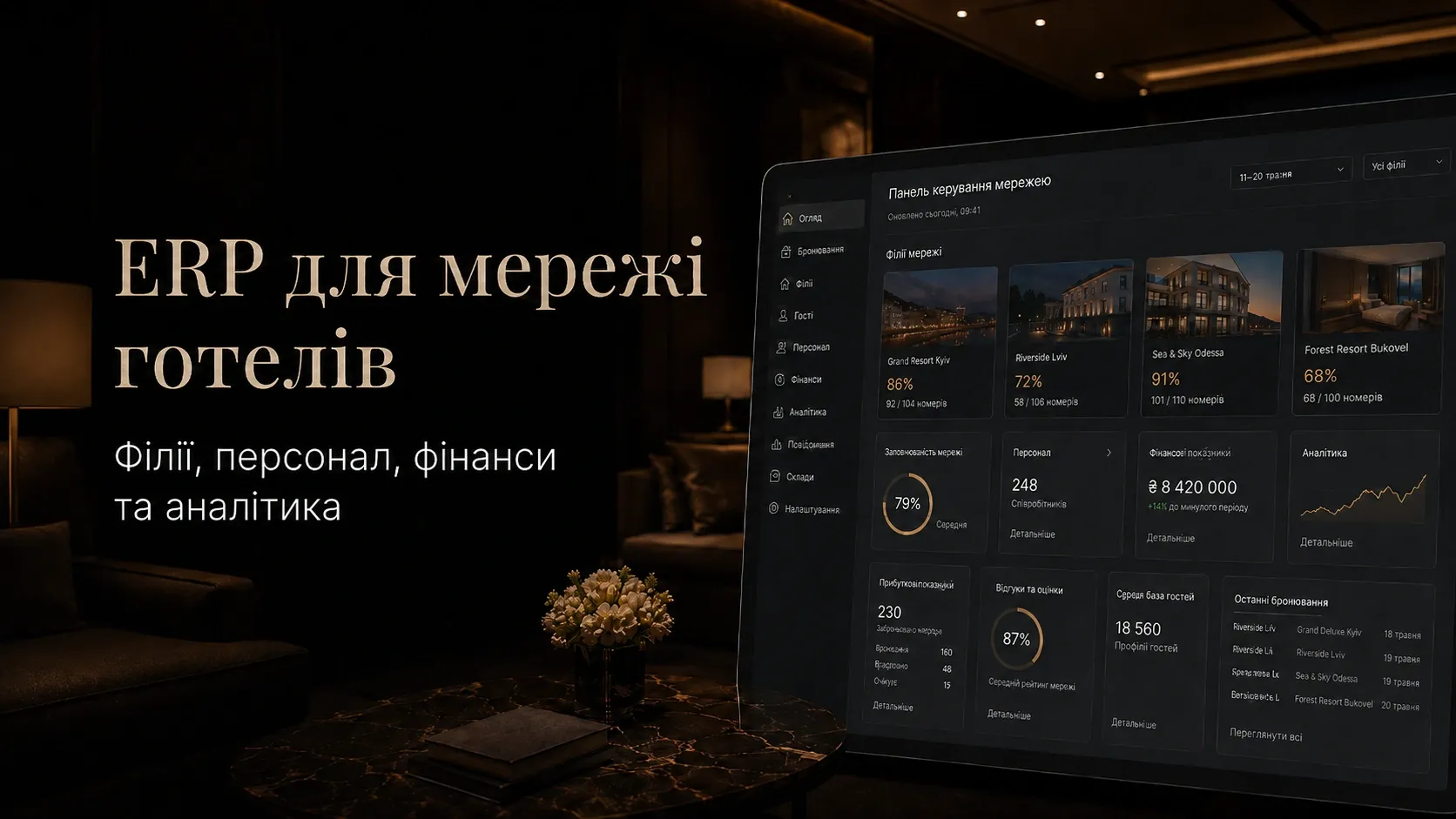
Managing a hotel chain involves balancing dozens of processes: bookings, check-ins, room cleaning, procurement, financial control, and analytics. When each hotel operates in its own system or on paper, coordination costs rise, and the risks of data loss or errors become critical. The solution is implementing an ERP system that consolidates all processes into a single digital platform.
In this article, we’ll explore how ERP for hotel chains helps:
- Manage multiple properties with a centralized guest database and bookings.
- Control staff roles and access: from administrators to housekeeping.
- Automate financial flows, occupancy, and reporting.
- Optimize housekeeping, inventory, and logistics.
- Gain real-time analytics for decision-making.
Why Separate Systems and Excel Are a Risk for Hotel Chains
Many hotel chains start with each hotel managing its own data in Excel or a local PMS (Property Management System). At first glance, this seems flexible and cost-effective, but as the chain grows, problems arise:
- Fragmented Data: Guests who book rooms at different properties lack a unified history. If a guest leaves a review at one hotel, the information won’t reach another.
- Manual Reporting: Financial reports are compiled manually from each hotel, consuming time and increasing the risk of errors.
- Lack of Control: It’s impossible to track room occupancy, inventory status, or staff task completion in real time.
- Logistics Issues: Each hotel orders supplies independently, preventing centralized procurement and bulk discounts.
An ERP system solves these problems by consolidating all processes into a single database. For example, if a hotel in Lviv has vacant rooms while Kyiv experiences high demand, the system can automatically redirect bookings or offer discounts to balance occupancy.
Key ERP Modules for Hotel Chains
1. Managing Branches and a Unified Guest Database
ERP allows you to manage all hotels from a single dashboard. You can see:
- Unified Guest Registry: Booking history, reviews, and preferences (e.g., pillow type or upper-floor rooms).
- Centralized Booking: If a hotel in Kharkiv is fully booked, the system can suggest an alternative in Dnipro.
- Price and Promotion Management: Dynamic pricing based on season, demand, or local events (e.g., raising prices during a festival).
Example: An apartment hotel chain can use a unified database for a loyalty program. A guest earns points at one hotel and redeems them at another without additional coordination.
2. Staff Roles and Access
In a hotel chain, dozens of employees perform different tasks: administrators, housekeeping, managers, accountants. ERP allows you to configure flexible roles with varying access levels:
| Role | Access |
|---|---|
| Administrator | Full access to all modules: bookings, finances, reporting. |
| Hotel Manager | Access to bookings, occupancy, and tasks for their hotel. |
| Housekeeper | Access to cleaning tasks, room status, and inventory. |
| Accountant | Access to financial reports, payments, and tax documentation. |
| Logistician | Control over inventory, orders, and supply between branches. |
Example: A housekeeper receives cleaning tasks via a mobile ERP app. After completing the task, they update the room status, and the system automatically reflects it in the booking system.
3. Finances and Analytics
The ERP financial module enables:
- Consolidated Reporting: Gather data from all hotels in one place and automatically generate financial reports for owners or investors.
- Expense Control: Track spending on procurement, utilities, salaries, and other operational costs.
- Profitability Analysis: Identify which branches generate the most revenue, which rooms are most popular, and which need promotion.
- Demand Forecasting: Use historical data to plan procurement and staffing.
Example: If analytics show that sea-view rooms in Odesa are booked 30% more often than standard rooms, you can raise prices or launch a targeted ad campaign.
4. Booking and Occupancy Management
ERP automates the booking process, reducing staff workload:
- Online Booking: Integration with your website, Booking.com, Airbnb, and other sales channels.
- Automatic Confirmations: Emails or SMS with booking details and check-in information.
- Occupancy Balancing: If one hotel is overbooked, the system can suggest an alternative at another property.
- Dynamic Pricing: Adjust prices based on season, demand, or events (e.g., raising prices during a festival).
Example: During a football championship in Kharkiv, ERP can automatically raise room prices and offer packages with transfers to the stadium.
5. Housekeeping and Room Management
The housekeeping module allows:
- Task Assignment: The system automatically generates cleaning tasks based on bookings (e.g., cleaning after check-out).
- Quality Control: Housekeeping staff update room status (clean, needs repair, booked) via a mobile app.
- Inventory Management: Track linen, towels, and cleaning supplies.
- Prompt Response to Complaints: If a guest leaves feedback about a dirty room, the system immediately creates a task for housekeeping.
Example: If a guest checks out at 12:00 PM, ERP automatically schedules cleaning for that time and notifies the housekeeper via a Telegram bot.
6. Inventory and Logistics Management
Centralized inventory management helps:
- Track Stock Levels: Monitor supplies at each hotel (linen, toiletries, minibar items).
- Automate Procurement: The system generates orders to suppliers when stock reaches a minimum level.
- Redistribute Resources: If one hotel has excess towels while another faces a shortage, ERP can suggest redistribution.
- Control Expiry Dates: For minibar items or toiletries.
Example: If a hotel in Ivano-Frankivsk runs out of shampoo, ERP can automatically order it from a supplier or redistribute it from the Chernivtsi warehouse.
7. Reporting and Analytics for Chains
ERP provides real-time analytics tools:
- Room Occupancy: Data on occupancy for each hotel by day, week, or month.
- Financial Reports: Profitability, expenses, and ROI for each branch.
- Guest Reviews and Ratings: Analyze guest feedback to improve service.
- Staff Productivity: Track task completion and identify errors.
- Demand Forecasting: Use historical data to plan procurement and staffing.
Example: Analytics might show that a hotel in Lviv has the highest average check due to additional services (breakfast, transfers), while a hotel in Uzhhorod has a lower average check due to the lack of these services. Based on this data, you can standardize offerings across the chain.
How to Choose an ERP for Your Hotel Chain
When selecting an ERP system, consider these criteria:
- Flexibility and Scalability: The system should grow with your chain, allowing easy addition of new properties.
- Integrations: Ability to connect to sales channels (Booking.com, Airbnb), payment systems, and accounting software.
- Mobile Access: Staff should be able to access the system via smartphones (e.g., for housekeeping or managers).
- Data Security: Protection of guest personal data and financial information.
- Support and Training: Availability of technical support and training materials for staff.
- Cost: Evaluate not only the initial implementation cost but also ongoing maintenance and updates.
Tip: Start with a pilot project at one hotel to test the system and identify potential issues before rolling it out across the chain.
Conclusion: ERP as a Foundation for Hotel Chain Growth
An ERP system for hotel chains is more than just an automation tool—it’s a strategic asset that helps:
- Reduce Operational Costs: Through automation of manual processes and centralized management.
- Improve Service Quality: With a unified guest database, quick response to requests, and quality control.
- Make Informed Decisions: Based on analytics and demand forecasting.
- Scale the Business: Quickly add new properties and integrate them into the system.
If your chain is still managed through separate Excel files or local PMS, it’s time to transition to a unified platform. This will not only optimize current processes but also create a foundation for future growth.
Remember: ERP isn’t an expense—it’s an investment in the stability and profitability of your business.
Ready to unify your hotel chain into one system?
We develop custom ERP systems for hotel chains that integrate bookings, finances, staff, and analytics. Let us create a solution that optimizes your processes and increases profitability.
FAQ
Can ERP be implemented in just one hotel of the chain?
Yes, you can start with a pilot project at one hotel. This allows you to test the system, identify potential issues, and prepare staff before rolling it out across the entire chain. After successful testing, the ERP can be scaled to other properties.
How does ERP help save on procurement?
ERP allows you to centralize procurement for all hotels in the chain. You can secure bulk discounts from suppliers, monitor inventory levels, and redistribute items between properties to avoid excess or shortages.
Do staff need training to use ERP?
Yes, staff training is a crucial part of ERP implementation. While most systems have intuitive interfaces, understanding all features is essential for efficient use. Many vendors offer training materials and technical support to ease the adaptation process.
How does ERP integrate with sales channels like Booking.com or Airbnb?
Modern ERP systems for hotels offer integrations with major sales channels. This enables automatic synchronization of bookings, prices, and room availability between the ERP platform and external services, preventing double bookings and errors.
Can ERP be managed via a mobile app?
Yes, most hotel ERP systems have mobile apps or responsive web interfaces. This allows staff (e.g., housekeeping or managers) to receive tasks, update room statuses, and view reports from anywhere.