AI for Beauty Salons: How to Automate Responses, Bookings, and Repeat Sales
How artificial intelligence can replace a receptionist in a beauty salon: from handling inquiries to personalized recommendations and demand forecasting. Practical automation scenarios without the hype.
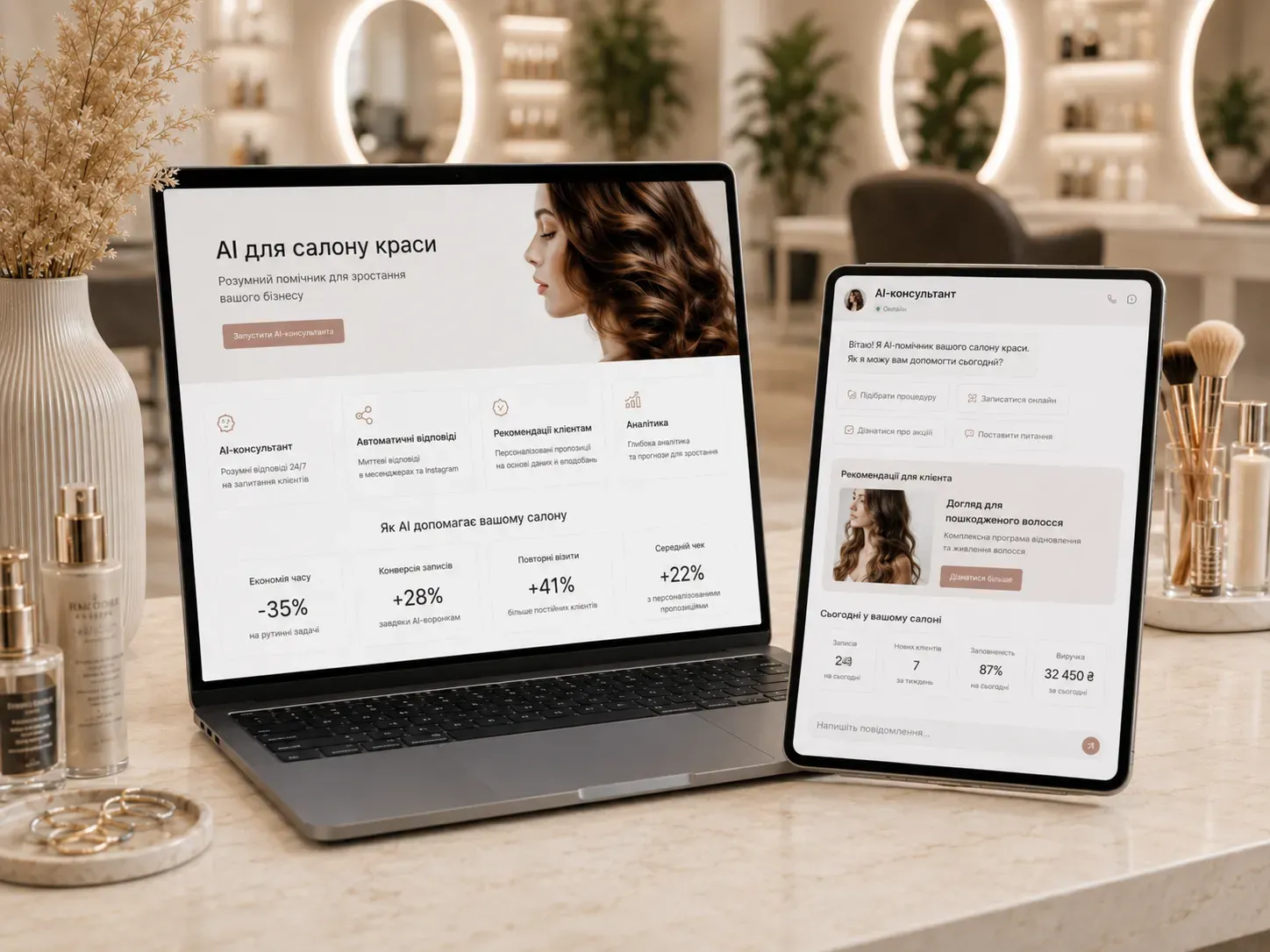
In beauty salons, the receptionist is the face of the business. Their communication skills, response speed, and attention to detail determine whether a client will return, leave a positive review, or book a service immediately. But what happens when the receptionist can’t keep up with messages, forgets to remind clients about repeat visits, or fails to suggest personalized offers in time?
The solution is integrating artificial intelligence (AI) into client service. This isn’t about replacing humans with robots but freeing up your team from routine tasks so they can focus on what truly requires human attention: consultations, sales, and high-quality service.
This article explores how AI can take over handling inquiries, client bookings, sending reminders, personalizing offers, and even forecasting salon demand. No hype—just practical scenarios already working in the beauty business.
Why Beauty Salons Need AI: Real Problems and Their Costs
Every day, beauty salons face typical operational challenges:
- Lost leads due to slow responses. A client messages on Instagram or Telegram at 8 PM when the receptionist is off duty. They don’t get a reply until the next morning and book a service elsewhere.
- Manual booking. The receptionist spends 3–5 minutes on every call or message to clarify the service, master, time, and client details. There can be dozens of such inquiries in a day.
- No repeat sales. There’s no system to remind clients about follow-up procedures (e.g., eyebrow correction or manicure). Clients forget, and the salon loses revenue.
- Low conversion to sales. The receptionist may not always have the time or skills to upsell additional services during booking.
- Booking errors. Human mistakes: wrong time, master, or service recorded. This leads to conflicts and reputational damage.
- Lack of analytics. It’s impossible to predict salon demand for the next month to optimize master schedules or launch promotions.
The cost of inaction isn’t just lost clients and revenue—it’s also team burnout, as they waste energy on repetitive tasks instead of growing the business.
How AI Solves These Problems: Practical Scenarios
1. AI Consultant: Handling Inquiries and Client Bookings
An AI consultant is a chatbot that works in Instagram Direct, Telegram, or on the salon’s website. It can:
- Instantly answer common questions: service prices, working hours, address, available slots.
- Collect booking data: clarify the service, master, convenient time, and client details (name, phone).
- Automatically record bookings in CRM: client data and booking details go straight into the system, eliminating manual input.
- Send visit reminders: a day before the appointment, send an SMS or messenger notification for confirmation.
- Handle cancellations and rescheduling: if a client wants to change the time or cancel, the bot suggests alternatives and updates the system.
Example of AI consultant in action:
- A client messages on Instagram: “Hi! How much is a men’s haircut?”
- The bot replies instantly: “Welcome! A men’s haircut starts at $15. What day and time would you like to book?”
- The client selects a date and time.
- The bot asks for their name and phone to confirm the booking.
- After confirmation, the data goes into the CRM, and the client receives booking details.
Benefits:
- Fast response (24/7, even outside working hours).
- Reduced workload for the receptionist.
- Fewer booking errors.
2. Personalizing Offers: How AI Increases Average Spend
AI can analyze a client’s purchase history and suggest personalized services or promotions. For example:
- If a client regularly gets manicures, the bot can offer a discounted subscription or an additional service (e.g., gel polish coating).
- If a client books a haircut, the bot can suggest adding coloring or hair care.
- For loyal clients: personalized discounts or birthday gifts.
How it works:
- AI analyzes CRM data (purchase history, visit dates, chosen services).
- It generates a personalized offer based on this data.
- The offer is sent to the client via SMS, email, or messenger.
Example:
“Olena, we noticed you’ve visited us for a manicure 3 times recently. We’d like to offer a 5-visit subscription with a 15% discount. You can book it here [link].”
Benefits:
- Increased average spend.
- Higher client loyalty.
- Reduced marketing costs for attracting new clients.
3. Client Segmentation: Who Gets What Offer
Not all clients are the same. Some visit once a year, others monthly, and some only buy discounted services. AI helps segment the client base and tailor communication to their behavior.
Client segments for beauty salons:
| Segment | Characteristics | Communication Strategy |
|---|---|---|
| New clients | First visit or up to 3 visits | First-service discount offer |
| Regular clients | 4+ visits in the last 6 months | Subscriptions, personalized discounts, gifts |
| At-risk clients | Haven’t visited in 3+ months | Return offers, personalized invitations |
| VIP clients | High average spend, regular visits | Exclusive services, priority booking |
| Discount clients | Only buy discounted services | Minimal-discount offers, bundled services |
How AI helps with segmentation:
- Automatically categorizes clients based on CRM data.
- Generates personalized offers for each segment.
- Sends communication at the client’s preferred time (e.g., 2 days before a promotion ends).
4. Demand Forecasting: Optimizing Master Schedules
AI can analyze past salon demand data to predict future service demand. For example:
- Which days of the week have the highest demand for haircuts?
- What time of day are manicures most frequently booked?
- Which services are popular in summer vs. winter?
How to use this data:
- Optimize master schedules: more masters on high-demand days, fewer on low-demand days.
- Launch promotions for low-demand services (e.g., a discount on hair coloring on Mondays).
- Plan master days off during low-demand periods.
Example: If AI predicts high demand for manicures on Saturday, the salon can:
- Increase the number of masters available that day.
- Launch a “Manicure + Pedicure 20% off” promotion to boost average spend.
- Open additional booking slots.
5. Message Generation: How AI Writes Texts for You
Writing messages to clients is a repetitive task that takes up a lot of time. AI can generate:
- Booking confirmations: “Hi Olha! You’re booked for a haircut on June 15 at 2 PM with master Iryna. We’ll see you at Shevchenko St, 10. See you soon!”
- Visit reminders: “Olha, just a reminder: you have a haircut appointment tomorrow at 2 PM. If you need to reschedule, let us know.”
- Personalized offers: “Ivan, it’s been a while since your last visit! We’d like to offer 20% off your next haircut. Book here [link].”
- Answers to common questions: “A men’s haircut starts at $15. Our working hours: Mon–Sat 9 AM–8 PM, Sun—closed.”
How it works:
- The receptionist sets up message templates.
- AI inserts client-specific data (name, service, time) and sends the message.
Benefits:
- Saves receptionist time.
- Ensures consistent communication style.
- Allows sending messages at the client’s preferred time.
6. Quality Control: How AI Monitors Service
AI can analyze client reviews to identify salon service issues. For example:
- Review monitoring: AI scans reviews on Instagram, Google, or the salon’s website for negative comments (e.g., “waited too long for the master” or “poor service”).
- Categorizing inquiries: AI sorts messages by topic (bookings, service quality, staff attitude) and forwards them to the responsible employees.
- Automated review responses: AI can generate replies to both positive and negative reviews (e.g., “Thank you for your feedback! We’ll definitely resolve this issue.”).
Example: If a client leaves a review: “Waited too long for the master; booked for 3 PM but was seen at 3:30,” AI can:
- Detect the negative review.
- Categorize it as a “booking issue.”
- Notify the receptionist to resolve it.
- Generate a response: “We apologize for the inconvenience! We’ll take steps to ensure this doesn’t happen again.”
Benefits:
- Quick response to issues.
- Improved service quality.
- Increased client satisfaction.
How to Implement AI in a Beauty Salon: Step-by-Step Plan
Implementing AI isn’t about buying a “magic box” but integrating technologies into existing business processes. Here’s a step-by-step plan:
Step 1: Identify Pain Points
Analyze which processes in the salon take the most time or lead to client loss. For example:
- Slow responses to messages.
- Lost bookings due to receptionist errors.
- Lack of repeat sales.
Step 2: Choose the Right Tools
Depending on your needs, you might require:
- AI consultant for handling inquiries and bookings (e.g., a chatbot in Telegram or Instagram).
- CRM system to store client data and automate communication.
- Analytics tools for demand forecasting and client segmentation.
- Message generator to automate communication.
Step 3: Integrate AI with Existing Systems
AI should work seamlessly with your CRM, website, messengers, and other tools. For example:
- An Instagram chatbot should integrate with the CRM so client data goes straight into the system.
- The message generator should have access to client data for personalization.
Step 4: Train Your Team
AI is a helper, not a replacement for your team. It’s important to train employees:
- How to work with new tools.
- How to monitor AI performance (e.g., checking generated messages before sending).
- How to use AI data for decision-making (e.g., analyzing demand forecasts to plan master schedules).
Step 5: Test and Optimize
After implementing AI:
- Monitor effectiveness: Has the number of lost leads decreased? Has the average spend increased?
- Gather feedback from clients and the team.
- Optimize processes based on the data.
Conclusion: AI Is a Tool, Not Magic
Artificial intelligence won’t solve all your salon’s problems overnight. It’s a tool that helps automate routine tasks, improve service quality, and increase revenue—but only when integrated into existing business processes and complemented by human attention.
If you want to implement AI in your salon, start small: automate inquiry handling or reminder sending. Gradually add new features, analyze results, and optimize processes. This way, you’ll build an efficient system that works for you 24/7.
The key is not to wait until competitors outpace you in using technology. AI is here, and it’s ready to help your salon become better.
Ready to automate client service in your salon?
SwiftyFlux will help implement AI solutions that replace routine tasks, boost client loyalty, and increase sales. We integrate chatbots, CRM, analytics, and message generators into your business processes—without complex technical details.
FAQ
Can AI completely replace a receptionist in a beauty salon?
AI can’t completely replace a receptionist, but it can take over routine tasks: handling inquiries, bookings, sending reminders, and personalizing offers. This frees up the receptionist to focus on more complex tasks like consultations and sales.
How does AI help increase repeat sales in beauty salons?
AI analyzes clients’ purchase histories and generates personalized offers: subscriptions, discounts on repeat services, or additional services. It can also automatically remind clients about follow-up visits (e.g., eyebrow corrections).
Is it difficult to implement AI in a small beauty salon?
Implementing AI doesn’t require large investments or complex technical knowledge. You can start with simple solutions like a chatbot for handling inquiries or a message generator. The key is integrating AI with existing tools (CRM, messengers) and training the team to work with new technologies.
What data does AI need to work in a beauty salon?
AI needs CRM data: clients’ purchase histories, visit dates, chosen services, and contact details. The more data available, the more accurately AI can generate personalized offers and forecast salon demand.
How does AI help control service quality in a beauty salon?
AI can analyze client reviews on platforms like Google and Instagram to detect negative comments. It can also categorize inquiries by topic (bookings, service quality) and forward them to the responsible employees for resolution.