
Why Dental Clinics Lose Patients Without a Website, CRM, and Automation
Explore how the absence of a website, CRM, and automation leads to lost leads, patient trust, and repeat visits. A systematic solution for dental clinics.
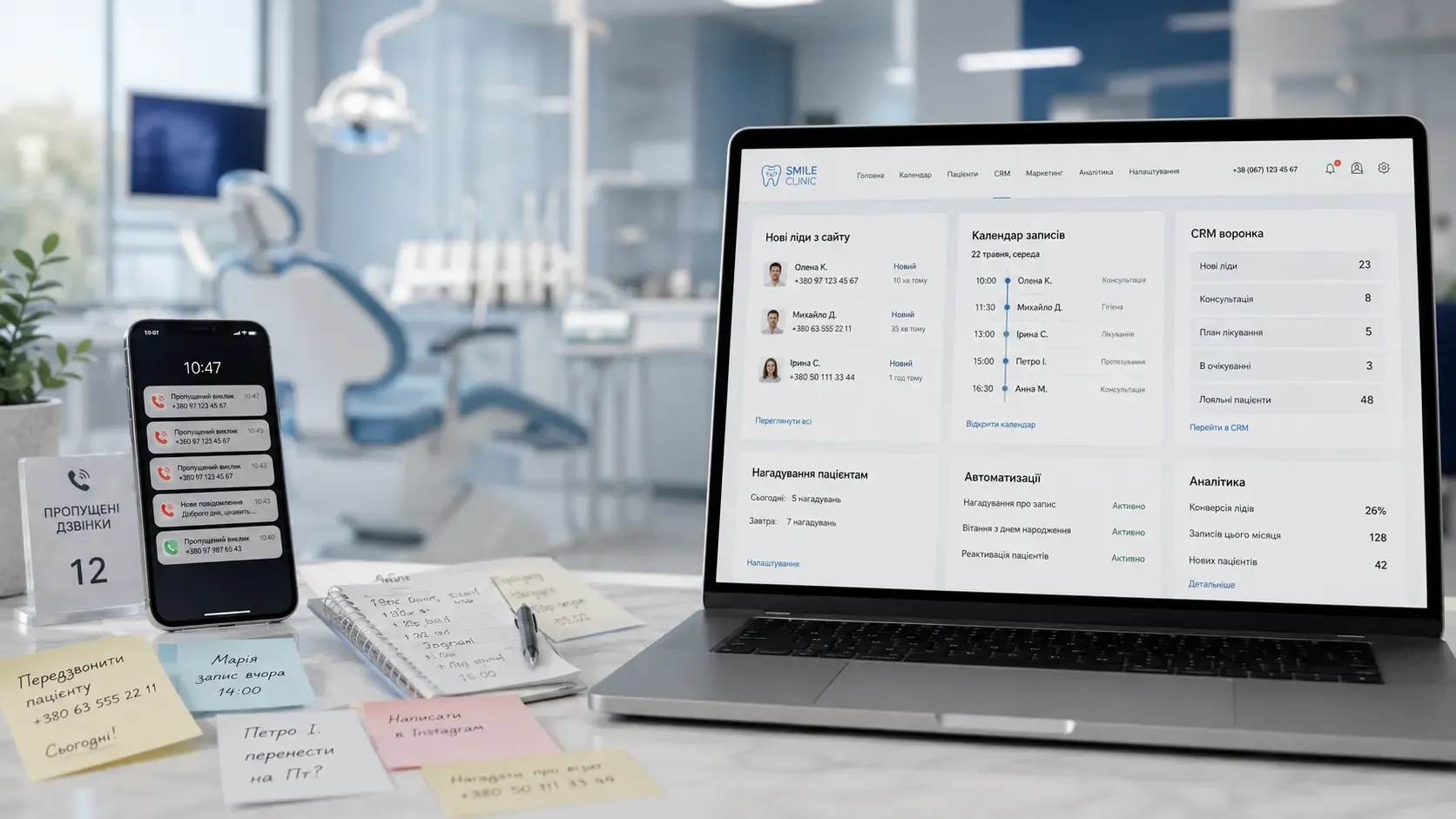
Every dental clinic owner knows: patients don’t appear out of nowhere. They need to be attracted, convinced of professionalism, conveniently booked for an appointment, and reminded of their next visit. However, if your clinic lacks a website, CRM, or process automation, you lose patients at every stage—from the first Google search to repeat appointments.
Let’s examine the typical problems and show how a systematic approach with a website, CRM, automation, and a Telegram bot transforms chaos into a controlled patient flow.
Why Dental Clinics Lose Patients: 5 Key Problems
1. No Trust in Google — The Clinic Is Invisible to New Patients
When a potential patient searches for a dentist, they open Google and type queries like “dental clinic [city]” or “cavity treatment.” If your clinic isn’t in the search results or has an outdated, non-informative, or non-mobile-friendly website, the person will simply choose a competitor.
Consequences:
- Patients can’t find your clinic online.
- Google Ads or social media ads perform poorly because users land on a low-quality website.
- The lack of reviews or their unstructured placement reduces trust levels.
2. Leads from Ads Are Processed Manually — Lost Leads and Revenue
You launched an ad campaign, and it’s generating leads. But if they come to a receptionist’s phone or email without automatic recording, some will inevitably be lost:
- The receptionist can’t answer all calls or messages in time.
- Patient information isn’t stored in the system—there’s no history of interactions.
- It’s impossible to track which ads brought more clients.
Consequences:
- Up to 30% of leads are lost due to human error.
- Ad budgets are spent inefficiently.
- Patients choose clinics that respond faster.
3. Receptionists Can’t Keep Up — Overload and Mistakes
In manual mode, a receptionist must:
- Answer calls and messages manually.
- Record patient data in a notebook or Excel.
- Manually remind patients of appointments (calls, SMS, Viber).
- Track payments and treatment history.
Consequences:
- Errors in bookings, double reservations, missed appointments.
- High staff workload—receptionists burn out and make more mistakes.
- Patients receive poor service and don’t return.
4. Patients Aren’t Reminded of Appointments — Missed Visits and Lost Revenue
Studies show that up to 20% of patients forget about scheduled dental appointments. If the clinic doesn’t remind them a day or two before the visit, these slots remain empty.
Consequences:
- Doctor downtime and lost potential revenue.
- Patients don’t receive treatment on time, worsening their health.
- The lack of a reminder system reduces patient loyalty.
5. No Repeat Sales — Patients Don’t Return
Most dental services require repeat visits: check-ups, root canal treatment, professional hygiene. If the clinic doesn’t track treatment history, analyze patient needs, or offer convenient ways to rebook, they simply go to competitors.
Consequences:
- Loss of regular clients and stable income.
- The need to constantly attract new patients, which is more expensive than retaining existing ones.
- Patients don’t receive the full range of services, reducing the average bill.
Systematic Solution: Website + CRM + Automation + Telegram Bot
To eliminate these problems, a comprehensive approach is needed, combining:
- A modern website — your clinic’s business card online.
- A CRM system — for processing leads, bookings, and patient history.
- Process automation — to minimize manual work and eliminate errors.
- A Telegram bot — for quick booking, reminders, and communication with patients.
Let’s see how this works in practice.
1. Website for Dental Clinics: The First Step to Trust
A website isn’t just an online business card—it’s a tool for attracting and retaining patients. It should meet several key requirements:
- Responsive design: convenient viewing on any device.
- Informative content: list of services, prices, doctor information, patient reviews.
- Online booking: the ability to schedule an appointment without calling.
- SEO optimization: so the clinic is visible in Google search results.
- CRM integration: so leads from the website automatically enter the system.
Example: A patient finds your website via Google, explores services, reads reviews, and books an appointment in 2 minutes—without calls or waiting.
2. CRM for Dental Clinics: Control Over Leads and Patients
A CRM system helps:
- Collect all leads in one place: calls, messages from the website, social media, Telegram.
- Automatically record patient data: name, contacts, interaction history, treatment.
- Track lead status: new, in progress, scheduled, completed.
- Analyze ad effectiveness: which campaign brought more patients.
- Maintain treatment history: so the doctor sees which services were already provided.
Example: A patient leaves a request on the website. It automatically enters the CRM, where the receptionist sees the status and can quickly schedule an appointment.
| Before | After |
|---|---|
| Leads get lost, no patient history | All data is stored in the system, no lead is lost |
| Manual booking, double reservations | Automatic booking with availability check |
| No ad analytics | Clear understanding of which ads work |
3. Dental Clinic Automation: Less Manual Work, More Time for Patients
Automation allows:
- Reminding patients of visits: via SMS, email, or Telegram 1-2 days before the appointment.
- Sending appointment confirmations: so the patient can confirm or reschedule.
- Collecting reviews: automatically sending a review request after the visit.
- Informing about promotions and discounts: to stimulate repeat visits.
- Automatically generating reports: on the number of patients, revenue, doctor effectiveness.
Example: A patient books an appointment. The system automatically sends them an SMS reminder the day before and asks to confirm the visit.
4. Telegram Bot for Dental Clinics: Quick Booking and Communication
A Telegram bot can perform several important functions:
- Online appointment booking: the patient selects a service, doctor, and time.
- Appointment reminders: the bot sends a message before the visit.
- Answers to frequently asked questions: service costs, working hours, clinic address.
- Collecting reviews: after the visit, the bot asks to leave feedback.
- Service payments: integration with payment systems for convenient online payments.
Example: A patient messages the bot on Telegram: “Book a check-up.” The bot offers to choose a doctor and time, then confirms the booking.
How to Implement the System: A Step-by-Step Plan
- Audit current processes: identify weak points in the clinic’s operations.
- Develop a website: considering SEO and CRM integration.
- Choose and set up a CRM: connect all communication channels.
- Automate processes: reminders, confirmations, review collection.
- Create a Telegram bot: for booking and communication with patients.
- Train staff: so receptionists effectively use the new system.
- Monitor and optimize: analyze effectiveness and make adjustments.
Conclusion: Automation Isn’t a Luxury, It’s a Necessity
In today’s world, patients are used to speed, convenience, and personalized service. If your clinic still operates using old methods—without a website, CRM, or automation—you will inevitably lose patients, revenue, and competitive advantages.
A systematic solution with a website, CRM, automation, and a Telegram bot allows:
- Attracting more patients through the internet.
- Processing leads quickly and without losses.
- Reducing the workload on receptionists.
- Reminding patients of visits and reducing no-shows.
- Stimulating repeat sales and increasing the average bill.
Don’t wait for competitors to outpace you. Implement modern tools today and turn chaos into a controlled patient flow.
Ready to automate your dental clinic?
We’ll help implement a website, CRM, automation, and a Telegram bot so you don’t lose patients and increase revenue. Leave a request for a free consultation.
FAQ
Why does a dental clinic need a website if they have Instagram and Facebook?
Social media is a great communication channel, but it doesn’t replace a website. A website is your own platform where you fully control the content, SEO, and CRM integration. Patients search for dentists on Google, and if your website isn’t there, you lose potential clients.
Which CRM is best for a dental clinic?
The choice of CRM depends on the clinic’s size and needs. It’s important that the system supports integration with the website, Telegram, SMS mailings, and has the ability to track patient treatment history. It’s better to choose a CRM specialized in medical institutions.
Is it difficult to implement automation in a dental clinic?
If approached systematically, the process won’t be difficult. Start with auditing current processes, choose tools (CRM, website, bot), and gradually automate the most labor-intensive operations. Staff training and system testing are also important for successful implementation.
Can you do without a Telegram bot?
A Telegram bot is a convenient tool for quick booking and communication with patients, but it’s not mandatory. However, if your target audience actively uses Telegram, the bot will help improve service levels and reduce missed appointments.
How long does it take to implement a full system?
The timeline depends on the scope of work and the clinic’s readiness. Website development can take from 2 to 6 weeks, CRM setup—from 1 to 4 weeks, creating a Telegram bot—from 1 to 3 weeks. Full process automation can take from 1 to 3 months.