
Dental Clinic Mobile App: When It’s Necessary and When a Website Is Enough
Should a dental clinic invest in a mobile app if it already has a website and CRM? We analyze when an app truly enhances patient loyalty and streamlines operations—and when it’s just an unnecessary expense. Practical criteria for making the right decision.
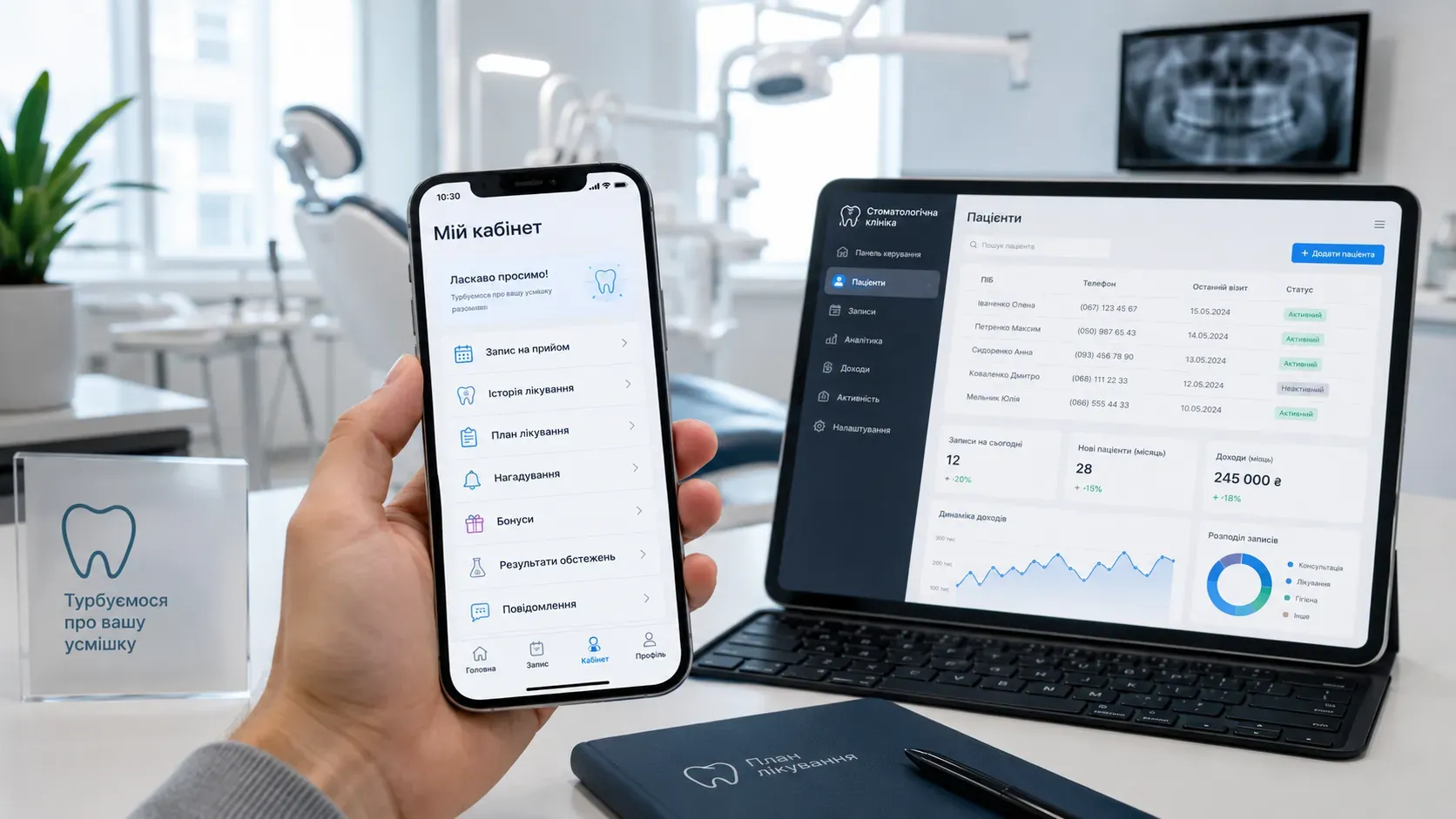
In the digital age, patients expect convenience at every step—from booking appointments to accessing treatment results. Many dental clinic owners wonder: Do we need a mobile app if we already have a website with online booking and a CRM? Won’t it just become a marketing checkbox that never pays off?
In this article, we’ll honestly explore:
- When a mobile app for a dental clinic provides real value and when it complicates the product unnecessarily.
- Which features patients truly need—and which are just marketing noise.
- How to compare a mobile app with a website, PWA, and Telegram bot to choose the best solution.
- What criteria will help determine if your clinic is ready for app development.
When a Mobile App for a Dental Clinic Is a Justified Investment
A mobile app becomes justified when a clinic faces one or more of these scenarios:
-
Large Base of Regular Patients If you have hundreds or thousands of patients who visit regularly (e.g., every 6 months for check-ups), an app simplifies communication and boosts loyalty. Patients receive push notifications for reminders, bonuses for timely visits, or offers for repeat appointments.
-
Chain of Clinics or a Large Medical Center For a network with multiple locations, an app standardizes the patient experience: they can book appointments with any doctor, view their treatment history across all clinics, and receive centralized notifications. This also simplifies data management for administration.
-
Active Loyalty Program If the clinic runs a bonus system (e.g., discounts for referrals or cumulative points), a mobile app makes it more convenient. Patients see their balance, receive notifications about bonus accruals, and can use them immediately when paying.
-
Complex Treatment Plan For clinics offering orthodontic treatment (braces, aligners) or implants, an app helps patients track treatment stages, receive visit reminders, and view test results (e.g., X-rays or progress photos).
-
High Market Competition In large cities where patients choose between dozens of clinics, a mobile app can become a competitive advantage. It signals modernity and care for patient convenience.
When a Mobile App Is an Unnecessary Expense
For a small dental clinic with 5–10 employees and a few hundred patients per year, a mobile app often doesn’t pay off. Key reasons:
-
High Development and Maintenance Costs. Even a basic app requires investment in design, development, testing, and updates. Moreover, it needs to be adapted for iOS and Android, as well as ensure compatibility with different OS versions.
-
Low Patient Engagement. If the clinic doesn’t have a loyal audience or unique services, patients simply won’t install the app. Even if they do, usage may be limited to one or two bookings per year.
-
A Website and CRM Are Enough. A fast website with online booking, a personal account, and CRM integration (e.g., for sending SMS reminders) can cover 90% of a small clinic’s needs. A Telegram bot can also handle functions like appointment booking or document sharing.
Which Features Are Truly Needed in a Dental Clinic App
Not all features offered by developers have practical value. Let’s break down which ones are truly important for patients and the clinic—and which can be excluded:
| Feature | Benefit for Patient | Benefit for Clinic | Should Include? |
|---|---|---|---|
| Online Appointment Booking | Quick booking without calls | Reduces administrative workload | Yes |
| Treatment History | Access to previous visits and diagnoses | Reduces manual work with paper records | Yes |
| Treatment Plan | Clear understanding of stages and costs | Increases transparency and trust | Yes |
| Push Notifications | Reminders about visits and bonuses | Reduces missed appointments | Yes |
| Loyalty Program | Ability to earn discounts and gifts | Boosts loyalty and repeat visits | Yes (if exists) |
| In-App Payment | Convenient payment | Reduces cashier workload | Yes (if integrated with payment system) |
| Access to Documents | Electronic prescriptions, bills, and reports | Reduces paperwork | Yes |
| Test Results | Access to X-rays, analyses, and photos | Simplifies patient communication | Yes (for complex cases) |
| Repeat Visits | Quick booking for next appointment | Increases repeat visits | Yes |
| Personal Account | Centralized access to all data | Reduces support requests | Yes |
| CRM Integration | Automatic patient data updates | Avoids data duplication | Yes |
Features That Often Turn Out to Be Unnecessary:
- Chat with Doctor. If a patient needs a consultation, they’ll call or book an appointment. An in-app chat can create additional workload for medical staff.
- Social Features (Reviews, Doctor Ratings). Reviews are better left on Google or the clinic’s website, and doctor ratings can create unnecessary internal competition.
- Virtual Consultation. For most dental services, an in-person visit is mandatory, so this feature is rarely relevant.
Mobile App, Website, PWA, or Telegram Bot: Which to Choose?
The choice between a mobile app, website, Progressive Web App (PWA), or Telegram bot depends on the clinic’s needs, budget, and technical capabilities. Let’s explore the pros and cons of each option:
| Criteria | Mobile App | Website with Personal Account | PWA | Telegram Bot |
|---|---|---|---|---|
| Development Cost | High | Medium | Medium | Low |
| Maintenance Cost | High | Medium | Medium | Low |
| Performance Speed | High | Depends on optimization | High | High |
| Accessibility | Requires installation | Available in any browser | Available in browser, can be added to home screen | Requires Telegram installation |
| Push Notifications | Yes | No (only email/SMS) | Yes | Yes |
| CRM Integration | Yes | Yes | Yes | Yes |
| Payment Capability | Yes | Yes | Yes | Limited |
| Patient Convenience | High | Medium | High | High |
| Suitable for Large Patient Base | Yes | Possible | Yes | No |
When to Choose a Mobile App:
- The clinic has a large base of regular patients willing to install the app.
- There’s an active loyalty program or complex treatment plan.
- The clinic has resources for app development and maintenance.
When to Choose a Website with a Personal Account:
- The budget is limited, but basic functionality (online booking, visit history) is needed.
- The clinic doesn’t have a large patient base or loyalty program.
- SEO optimization for attracting new clients is important.
When to Choose a PWA:
- You need mobile app functionality without high development costs.
- Patients aren’t willing to install an app but want mobile convenience.
- Speed and offline capability are important.
When to Choose a Telegram Bot:
- The budget is very limited, but appointment booking needs automation.
- Most patients already use Telegram.
- Complex features like treatment history or payments aren’t needed.
How to Determine If Your Clinic Is Ready for a Mobile App
Before investing in development, conduct a quick audit of your clinic using these criteria:
-
Patient Base Size
- If you have fewer than 1,000 active patients per year, an app likely won’t pay off.
- If you have more than 3,000, an app may be justified.
-
Frequency of Repeat Visits
- If patients visit less than once a year, they don’t need an app.
- If visits are every 3–6 months (e.g., for check-ups), an app can help retain patients.
-
Loyalty Program Existence
- If you already offer bonuses or discounts, an app makes them more convenient for patients.
-
Competition Level
- If there are many dental clinics in your city or area, an app can be a competitive advantage.
- If you’re the only clinic in town, an app isn’t a priority.
-
Technical Readiness
- Do you have a CRM that can integrate with the app?
- Are you ready to invest in marketing to promote the app?
- Do you have a team or contractor for app support and updates?
-
Patient Feedback
- Conduct a small survey among regular patients: Are they willing to install the clinic’s app?
- If most answer positively, it’s a good sign.
Practical Steps to Launch a Mobile App
If you’ve decided that a mobile app is needed for your clinic, follow this plan:
-
Define Goals and Functionality
- List features that are truly needed for patients and the clinic.
- Exclude unnecessary features that won’t be used.
-
Choose a Technological Solution
- Native development (separate for iOS and Android) is suitable for large projects with high performance requirements.
- Cross-platform development (e.g., Flutter or React Native) is cheaper and faster but may have performance limitations.
- PWA can be an intermediate option if you’re not ready for a full-fledged app.
-
Develop Design and Prototype
- Create a prototype with key screens (e.g., appointment booking, personal account, visit history).
- Test the prototype with real patients to identify weaknesses.
-
Develop an MVP (Minimum Viable Product)
- Launch the app with basic functionality (e.g., online booking, visit history, push notifications).
- Avoid excessive complexity at the start.
-
Integrate with CRM and Other Systems
- Set up data synchronization between the app, CRM, and other clinic tools.
- Ensure patient data updates in real time.
-
Launch and Promote the App
- Prepare a marketing campaign for the launch: email newsletters, website announcements, social media.
- Offer patients bonuses for installing and first using the app.
-
Gather Feedback and Improve the Product
- Analyze app usage: which features are popular and which aren’t.
- Regularly update the app, adding new features or fixing bugs.
Conclusion: Does Your Clinic Need a Mobile App?
A mobile app for a dental clinic is a powerful tool—but only if it solves real business challenges and enhances patient convenience. For small clinics with limited budgets, a fast website with a personal account, CRM, and Telegram bot is often sufficient. In this case, an app may be an unnecessary complication.
However, for clinic chains, large medical centers, or clinics with active loyalty programs, a mobile app becomes not just a convenience but a competitive advantage. It helps retain patients, simplifies communication, and improves service quality.
Before making a decision, audit your clinic using the criteria outlined in this article. If an app is truly needed, turn to a professional team that can help bring the project from idea to launch.
SwiftyFlux specializes in developing digital solutions for medical institutions: from websites and CRMs to mobile apps and business automation. We’ll help choose the best solution for your clinic and implement it with minimal risk.
Need a mobile app for your dental clinic?
We’ll help determine if your clinic is ready for app development and implement the project from idea to launch. SwiftyFlux specializes in digital solutions for medical institutions: websites, CRMs, mobile apps, and business automation.
FAQ
Does a small dental clinic need a mobile app?
For a small clinic with a limited budget and a few hundred patients per year, a mobile app often doesn’t pay off. A fast website with online booking, CRM, and a Telegram bot for communication automation is usually sufficient.
What features are essential in a dental clinic mobile app?
Essential features include: online appointment booking, treatment history, treatment plan, push notifications, access to documents, and CRM integration. A loyalty program and in-app payment are useful if the clinic actively uses them.
How is a mobile app better than a website or Telegram bot?
A mobile app offers faster performance, push notifications, and convenience for regular patients. However, it requires installation and is only suitable for clinics with a large patient base. A website and Telegram bot are cheaper to develop and maintain but have limited functionality.
How much does it cost to develop a mobile app for a dental clinic?
The cost depends on functionality, technologies, and the development team. A basic app can cost from $10,000, while a complex product with integrations and custom design can exceed $30,000. Maintenance and update costs should also be considered.
How to encourage patients to use the mobile app?
Offer bonuses for installing and first using the app, such as a discount on the next visit. Promote the app through email newsletters, the clinic’s website, social media, and offline advertising. Ensure the app is user-friendly and fast.