
Auto Service Automation: Which Processes Can Be Handled by a Website, CRM, and Telegram Bot
How to automate key auto service processes using a website, CRM, and Telegram bot. A practical guide for auto service owners: from client booking to analytics and repeat sales.
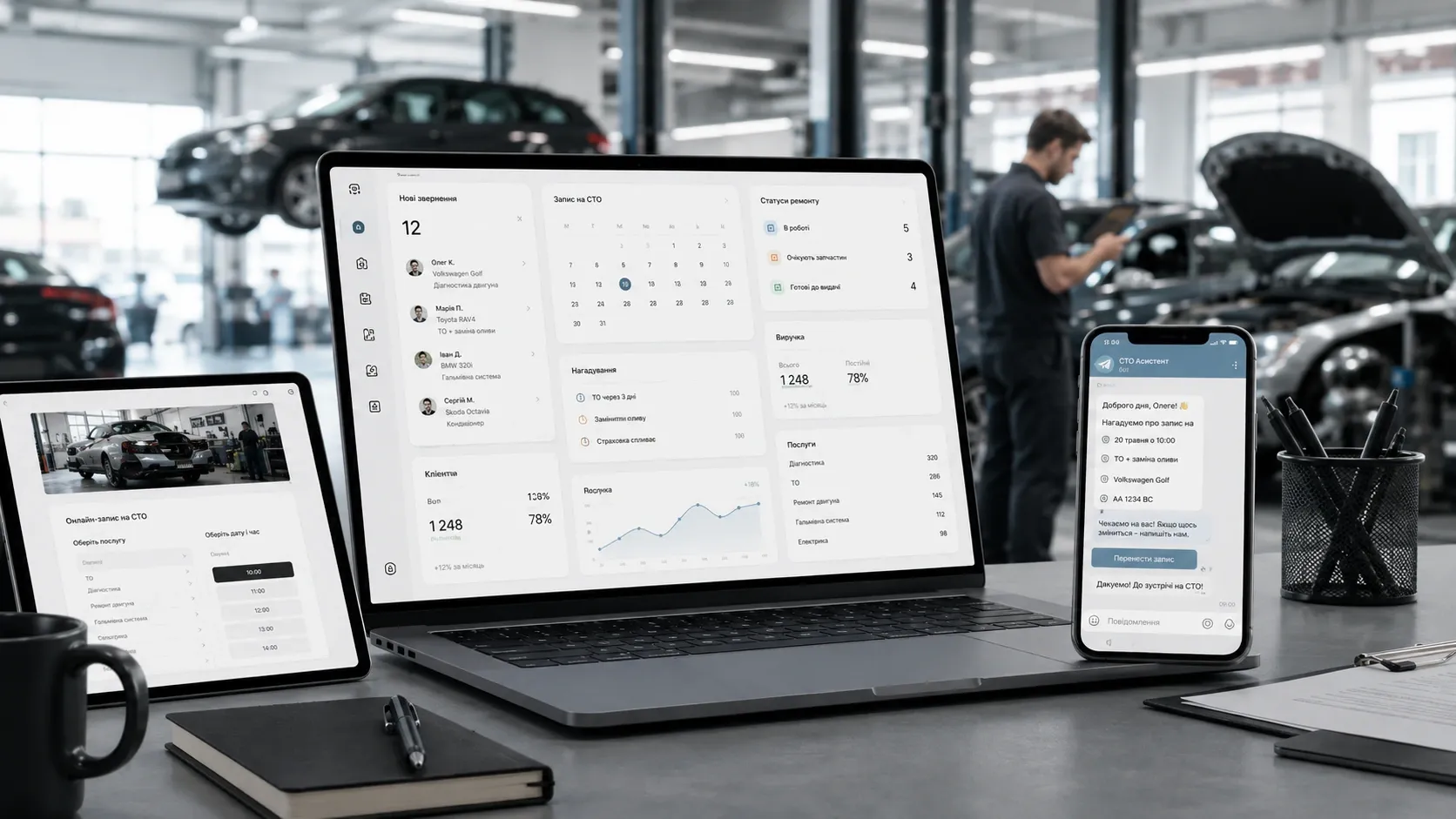
Owners and managers of auto service centers face numerous routine tasks that consume time, lead to errors, and reduce operational efficiency. Applications get lost in paper notebooks, clients forget about appointments, mechanics don’t see repair histories, and managers spend hours manually compiling reports. Auto service automation isn’t about replacing people with machines—it’s about eliminating repetitive tasks so the team can focus on what truly matters: high-quality client service and business growth.
In this article, we’ll break down which specific auto service processes can be digitized using tools like a website, CRM, Telegram bot, or mobile app. We’ll show how each of these tools solves real business challenges and where to start automation based on the size of your service center.
Key Auto Service Processes That Can Be Automated
1. Receiving Applications and Client Booking
Problem: Clients call at inconvenient times, managers forget to record details, and applications get lost in chats or notebooks. The result? Lost clients and empty slots in the schedule.
Solution:
- Website with online booking: Clients independently choose a service, time, and mechanic. The system automatically reserves the slot and sends a confirmation via email or SMS.
- Telegram bot: Convenient for regular clients who prefer messengers. The bot offers service selection, date, and time options, and reminds clients about their appointment a day before.
- CRM: All applications from the website, bot, and calls are collected in a single system. Managers see available slots, client history, and can quickly reschedule if needed.
Example: If a client books an appointment via the website at 10 PM when the office is closed, they still receive a confirmation, and the manager sees the application in the CRM the next morning.
2. Client Reminders
Problem: Clients forget about appointments, don’t notify about rescheduling or cancellations, leading to idle mechanics and lost revenue.
Solution:
- Automatic SMS or email reminders: The system sends a message a day before the appointment asking to confirm the visit.
- Telegram bot: Reminders with a “Yes/No” button for quick confirmation or cancellation.
- CRM: Records client responses and automatically reschedules or frees up slots in the schedule.
Advantage: Reduces the number of “gaps” in the schedule by 30-50%, allowing more clients to be served without additional costs.
3. Repair Status Tracking
Problem: Clients constantly call asking, “When will it be ready?” Managers waste time searching for information with mechanics or in notebooks.
Solution:
- Website or client portal: Clients see the repair status in real time (e.g., “Diagnostics,” “In Progress,” “Ready”).
- Telegram bot: Sends automatic updates about status changes.
- CRM: Managers and mechanics update the status in the system, and the client receives notifications instantly.
Example: If a mechanic completes diagnostics and changes the status to “Awaiting Confirmation,” the client receives a message with the cost and repair timeline.
4. Service History and Client Database
Problem: Information about previous repairs is stored in paper cards or the manager’s memory. When an employee leaves, critical client information goes with them.
Solution:
- CRM: Stores the full history of visits: what was repaired, which parts were used, cost, and client feedback.
- Client portal on the website: Clients see their service history and can leave reviews.
Advantage: Enables analysis of repeat visits, personalized service offers, and quality control of mechanic work.
5. Repeat Sales and Loyalty
Problem: Clients don’t return because they’re unaware of promotions, don’t receive maintenance reminders, or simply forget about the service.
Solution:
- CRM: Automatically identifies clients who need maintenance (based on mileage or last visit date) and sends personalized offers.
- Email or SMS campaigns: Inform about promotions, discounts on seasonal services (e.g., winter preparation).
- Telegram bot: Sends maintenance reminders with quick booking options.
Example: If a client had maintenance a year ago, the CRM automatically suggests booking the next service with an individual discount.
6. Analytics and Reporting
Problem: Managers spend hours manually compiling reports on applications, revenue, and mechanic workload. Data is often inaccurate or outdated.
Solution:
- CRM or web application: Automatically generates reports on key metrics:
- Number of applications per day/week/month.
- Average check.
- Mechanic workload.
- Most popular services.
- Repeat visit rate.
Advantage: Enables quick decision-making based on real data, not assumptions.
7. Manager Workflow
Problem: Managers forget to process applications, don’t check repair statuses, or make mistakes when generating invoices.
Solution:
- CRM with roles and tasks: Each manager sees their own task list (e.g., “Call client to confirm appointment,” “Generate invoice”).
- Automatic reminders: The system notifies about urgent tasks.
- Performance tracking: Supervisors see which managers completed tasks and who didn’t.
Example: If an application remains in “New” status for over an hour, the CRM reminds the manager and their supervisor.
8. Spare Parts Inventory Management
Problem: No clear inventory tracking, mechanics waste time searching for parts, and clients wait due to missing parts.
Solution:
- CRM with inventory integration: Tracks parts with the ability to reserve them for specific applications.
- Automatic ordering: If a part’s stock reaches a minimum, the system generates a supplier order.
- Repair status link: If a part is out of stock, the CRM notifies the manager and client about the delay.
Advantage: Reduces downtime due to missing parts and optimizes inventory levels.
How a Website, CRM, and Telegram Bot Work Together
Each tool solves specific tasks, but the maximum effect is achieved through integration:
| Tool | Main Function | Suitable For |
|---|---|---|
| Website | Online booking, client portal, service information | All auto services, especially those with a high volume of new clients |
| CRM | Application management, client database, analytics, manager workflow | Medium and large auto services, as well as service networks |
| Telegram Bot | Quick booking, reminders, repair status updates, repeat sales | Auto services where clients prefer messengers (especially younger audiences) |
| Mobile App | Convenient access to client portal, booking, notifications | Large auto services or networks requiring high client loyalty |
| Web App | Advanced functionality for managers and supervisors (reports, inventory) | Large auto services or networks needing deep analytics and automation |
Where to Start Auto Service Automation
You don’t need to implement all tools at once. The choice depends on the size of your auto service, budget, and key challenges:
-
Small Auto Service (1-3 workstations):
- Start with a Telegram bot for booking and reminders. It’s affordable and quick to implement.
- Add a website with online booking so clients can schedule appointments independently.
-
Medium Auto Service (4-10 workstations):
- Implement a CRM for managing applications, client databases, and analytics.
- Integrate the website and Telegram bot with the CRM for automatic application collection.
-
Large Auto Service or Network:
- Add a mobile app for clients and a web app for managers.
- Automate spare parts inventory and repeat sales through the CRM.
Selection Criteria:
- Budget: A Telegram bot is the cheapest option; CRM and website require larger investments.
- Client Flow: If you have many applications, a CRM is essential.
- Team Technical Preparedness: CRM requires employee training, while a Telegram bot is easy to use.
Automation Doesn’t Replace People
It’s important to understand: automation doesn’t eliminate the need for skilled employees. It removes routine so that:
- Managers can focus more on client communication.
- Mechanics aren’t distracted by searching for parts or clarifying repair details.
- Supervisors see the real business picture and can make informed decisions.
Example: A CRM doesn’t replace a manager but allows them to spend less time searching for paper applications and more time working with clients and closing deals.
Practical Recommendations
-
Start small: Choose one process that causes the most problems and automate it. For example, if clients often forget about appointments, start with automatic reminders via Telegram bot.
-
Involve the team: Explain the benefits of automation and conduct training. Without employee support, even the best solution won’t take root.
-
Choose flexible tools: The CRM or website should easily scale as your business grows. For example, if you currently have one service center but plan to open two more, choose a solution that supports multiple branches.
-
Test and adjust: After implementing a new tool, monitor key metrics. For example, if the number of applications doesn’t change after launching a Telegram bot, you may need to modify messages or add more booking buttons.
Conclusion
Auto service automation isn’t a luxury—it’s a necessity for businesses that want to stay competitive. A website with online booking, a CRM for managing applications and databases, and a Telegram bot for quick client communication—each of these tools solves specific business challenges, saves time, avoids errors, and increases revenue.
Start with the most pressing processes and gradually implement new tools. Remember, the goal of automation isn’t to replace people but to free them from routine and allow them to focus on business growth.
Ready to Automate Your Auto Service?
SwiftyFlux will help you choose and implement the optimal solutions for your auto service: from a website with online booking to a full-fledged CRM with Telegram bot integration and analytics. Contact us to discuss the details.
FAQ
Where is the best place to start automating an auto service?
Start with the most problematic process. For example, if clients often forget about appointments, begin with automatic reminders via Telegram bot or SMS. If applications get lost in chats, implement a CRM for centralized application collection.
Can an auto service be automated without a CRM?
Yes, but partially. For example, a Telegram bot or website with online booking can automate application intake, but without a CRM, it will be difficult to maintain a client database, analyze repeat visits, and monitor manager performance.
How long does it take to implement automation?
It depends on the complexity of the solution. A Telegram bot can be launched in a few days, a website with online booking in 2-4 weeks, and a CRM with inventory integration in 1-3 months.
Do employees need training to work with a CRM?
Yes, training is necessary. Even the best CRM won’t be useful if employees don’t know how to use it. Conduct training sessions and provide access to instructions.
How does automation help increase auto service revenue?
Automation allows you to serve more clients in the same amount of time (e.g., by reducing schedule gaps), reduce errors in invoice generation, and increase client loyalty through personalized offers and reminders.